

You can’t just build a high-quality website on a whim because you were bored on a Sunday afternoon. A high-quality website that will generate income for you requires a great deal of preparation and time. How do you set up the right workflow so that your website has a solid foundation, proper structure and a roof – and so you don’t end up with water running down your back right away?
1. Initial study
You’re entering the uncharted jungle of the internet. Do you know how to navigate the jungle? A manual is useless – it’s a jungle – there are trees, vines and wild animals everywhere, which, with a bit of luck, won’t try to eat you. What you need is a compass.
Before you start, carry out an initial study. An initial study is exactly that compass; it shows you which direction to take. As part of the study, you’ll define your target groups and competitors, and you’ll also set out how you want to stand out online and how to reach your customers. As part of the initial study, you’ll also set the goals you want to achieve.

2. Concept and strategy
Thanks to your compass, you’re already finding your way around the jungle a bit. You know which way to go to reach your goal. Now you just need to choose a route to get out of the jungle. You can get out of the jungle by heading north or west, but which route is better?
Thanks to the initial study, you know what you want to achieve – for example, a specific turnover or visitor numbers. Every page has its own goal. Write all the points down in a table or a clear document. A page without a concept or a goal has no place on the website. Organise the pages into a structure – this will help you design the menu, for example. A pre-prepared structure might look something like this:
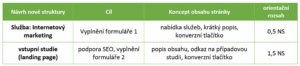
Now you have a map. You’ll have a clear idea of what’s important on the website, where everything belongs, and you’ll have a clear path to guide customers towards conversion.
3. Content
It’s time to set off on your journey using the map. You can think of copywriting as a guide. It’s something that advises you which way to go, which plants are poisonous, and that you shouldn’t provoke snakes.
Prepare your texts according to the structure. In the previous step, you outlined the scope and content of the texts. Keyword analysis is also part of copywriting. (Logically – you need a jungle guide now, not a guide to restaurants in Barcelona). Don’t forget to create personas (customer profiles) so you know who you’re addressing in your texts.
Why do you need to write the texts now? Wouldn’t it be enough to fill in “Lorem Ipsum”? Because if you do that, the texts won’t fit the design, or worse, they won’t actually say anything. Content is the most important building block of a website. Ultimately, content sells. Imagine content as a person who is simply dressed in graphics and code. Would you want to talk to someone who has nothing to say?
Even the respected Czech copywriter Roman Hřebecký says that anyone who uses Lorem Ipsum is simply slacking off; watch his talk and see for yourself:
4. Wireframes and graphics
In other words, you simply can’t do it without the right tools for the job.
Once you’ve finished your copy, pass it on to a graphic designer or project manager so they can design wireframes and insert the text into them. A wireframe shows the layout of elements on the page. It then serves as a guide for the coder on where to place the logo, buttons, etc.
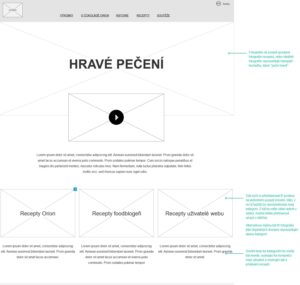
Nothing is set in stone; the text can, of course, be edited and changed as you go along, but it’s better to ensure it meets the site’s objectives. Once you’re happy with the wireframe structure, start creating the graphics. Wireframes act as a sort of template, making it much easier to change individual elements. The graphic designer can then focus solely on the aesthetic side of things.
5. Coding
You have everything you need for the journey; all that remains is to set off through the jungle.
Are you happy with the graphics? Excellent, now it’s the coder’s turn. They’ll take the graphics, wireframes, prepared structure and text and turn them into a fully functional website where buttons work, banners change and so on.
More and more users are using mobile devices to browse the internet. A mobile (or responsive) website is practically a necessity these days; up to 30% of users visit the average Czech website via a mobile phone or tablet. Don’t forget that Google gives mobile websites an advantage in search results.

6. A website that makes money
Have you noticed the sun shining through the trees? You’ve just reached the edge of the jungle, exactly where you were heading.
The website is ready. Before the final launch, don’t forget to test that everything works as it should. When launching a new website, you need to consider your existing marketing activities. Check where your PPC ads are leading and redirect the URLs so you don’t lose users unnecessarily.
If you want a website that actually makes money, don’t forget to test with users at every stage. This is the only way to eliminate all potential errors before users encounter them.
7. Marketing
Now all that’s left is to make the website widely known. There are plenty of options, ranging from SEO and PPC advertising, through social media and email marketing, to high-quality link building. Every website has a different target audience, so tailor your activities to where your users spend their time online and how they interact with the site.