The truth is that judging without thinking is based on prejudice. That’s why your grandmother still refuses to shake hands with a neighbour who has a tattoo. In her world, he’s a criminal. The fact that he has a PhD and rescues blind puppies in his spare time doesn’t matter.
We judge websites just as irrationally. At first glance, we decide whether we like it and whether we’ll stay. First impressions also determine a company’s credibility.
Simplicity wins
There’s no time for thinking or reading. According to a Google study, we form an initial impression of a website in as little as 50 milliseconds. (Gladwell, in his book *Blink*, kindly allows us a full 2 seconds, but that doesn’t change anything. You can’t even read the word ‘welcome’ in 2 seconds.) You can read the whole study online; the entire study is in English.
Two factors determine how a website is perceived:
- Prototypicality – how typical the design looks for a particular sector
- Complexity – how complex the website design appears. In other words, it is desirable for the website to be simple.
Complexity has a major influence on user interest, perception and behaviour. The negative correlation between website complexity and positive perception was also confirmed by further research in 2006.
Websites that are not overly complex are more effective from a communication perspective
and lead to better user responses.
Both factors are closely interrelated. A website that respects the unwritten rules of your industry will not be complex for users. Researchers have summarised the whole relationship in the following graph:
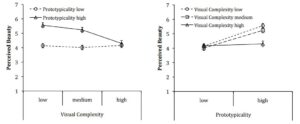
Users perceive websites that are typical and simple more favourably.
How to set positive expectations
The bias created by a website’s first impression can have far-reaching consequences. Research confirms that negative expectations of a product lead to lower satisfaction with the product, regardless of the facts.
How to win over users is a question that interests not only you, but also researchers. According to an analysis by Stanford University, 46% of people judge a website’s trustworthiness based on its design, more specifically on:
- the page structure,
- font type and size
- colours,
- contrast,
- images.
Conversely, barely 9% are interested in the website operator’s identity. Less than 1% are interested in the processing of their personal data.
What influences trustworthiness
|
Aspect influencing trust |
Percentage of respondents |
| Design, visual appearance | 46.1% |
| Information structure (clarity) | 28.5 |
| Information focuses on a single topic | 25.1% |
| Company theme | 15.5 |
| Usefulness of information | 14.8 |
| Accuracy of information | 14.3% |
| Reputation or awareness of the product/company | 14.1% |
| Advertising on the website | 13.8% |
| Engagement | 11.6% |
| Tone of communication | 9.0% |
| Identification of the website operator | 8.8% |
| Website functionality | 8.6% |
| Customer service | 6.4% |
| Previous experience with the site | 4.6% |
| Clarity of information | 3.7% |
| Readability | 3.6 |
Originality doesn’t pay off unless you’re a superbrand
What can we take away from the research? Forget about creativity! Only a brand like Apple or a highly reputable institution with enormous public credibility can afford that. The rest of us have to adapt to users.
Stick to what others are doing that works. A law firm, for example, cannot use a comic strip on its homepage – such an image does not match what users expect and will subconsciously reduce its credibility. On the other hand, it will help if it tells the user right at the start that, for example, it wins 30% of family law cases. If the design catches the eye straight away and the user also immediately sees the keyword they’re searching for, they’ll naturally get the impression that your firm understands them and will help. Generally speaking, if your website offers help, it comes across as more trustworthy. Keep this in mind when writing your text.
Don’t forget, too, that our eyes always find the dominant element. This element shouldn’t be a photo of your charming secretary, but rather a ‘Contact Us’ button.
Always place a dominant element like this above the fold – that is, in the part of the screen the user sees without scrolling. People don’t like scrolling, after all.
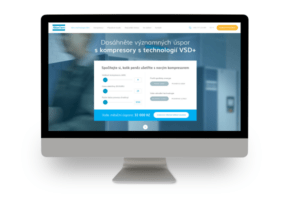
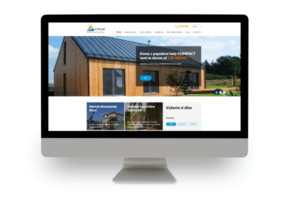
Take inspiration from our examples: