
Artificial intelligence in B2B marketing has evolved from a futuristic vision into a critical tool for survival and growth. 2026 will not be a year of experimentation, but a year of mass implementation and integration of AI into day-to-day operations. Whilst the B2C sector has focused primarily on volume and speed, B2B marketing is using AI to address its inherent challenges: long sales cycles, complex decision-making processes and the need for deep personalisation.
For businesses that sell to other businesses (B2B), AI is the key to transforming marketing from a cost centre into a predictive sales engine. In this article, we will look at key technologies, changes in workflow and practical steps for implementing AI in a B2B environment, including ethical and legislative aspects.
An overview of key AI technologies available in 2026
By 2026, AI is no longer just about ChatGPT. It is a sophisticated ecosystem of tools that integrate directly into CRMs, marketing automation platforms and data warehouses.
- Generative AI (GenAI) 2.0: It’s not just about generating text and images. GenAI 2.0 is capable of creating complete personalised campaigns, including landing pages, A/B tests and email sequences, based on behavioural data for a specific Account or Persona. It is typically integrated into tools such as Adobe Experience Cloud, Salesforce Einstein or HubSpot AI.
- Predictive AI (Predictive Scoring and Forecasting): This is key for B2B. Predictive models analyse historical data (demographics, content interactions, website visits) and assign a conversion probability score (MQL to SQL) or an LTV (Lifetime Value) score to every new lead/account. This allows marketing to know exactly where to allocate resources, and sales to prioritise the most promising contacts.
- Conversational AI and Co-pilots: Chatbots are a thing of the past. By 2026, they will be extensions of the human team. AI Co-pilots (e.g. integrated into Gmail, Slack, or CRM) help marketers write emails, analyse reports and suggest campaign optimisations in real time.
- Speech-to-Text and Sentiment Analysis: These technologies, primarily used for analysing sales calls and customer support, provide marketing with deep insights into customers’ real pain points and objections, which are then immediately reflected in content and messaging.
How AI is changing the work of marketers – roles, skills, workflow
AI will not replace marketers, but it will dramatically change their roles. Manual, repetitive tasks (e.g. keyword management, basic A/B testing, generating initial content drafts) will be automated. Marketers will shift towards the following key competencies:
- Data Architect and Integrator: The marketer of 2026 must understand how to link data from various systems (CRM, web, advertising) and how to ‘feed’ AI with high-quality, structured data. The quality of AI output is directly proportional to the quality of the data (Garbage In, Garbage Out).
- Strategic Editor and Proofreader: Most content will be generated by AI. The human role is to ensure authenticity, tone of voice, depth and ethical correctness. The marketer becomes a master of editorial work and a domain expert.
- Prompt Engineering (AI Guidance): The ability to ask AI tools the right, comprehensive and contextually rich questions (prompts) is becoming a key skill for maximising effectiveness.
- Ethics and Risk Manager: Given the regulations (see below), marketers must monitor whether AI leads to discrimination in targeting or the dissemination of false information.
Workflow Change: Instead of “Create a campaign”, the workflow shifts to “Audit data → Define prompts → Generate variants → Human review → Launch and optimise with AI oversight”.
Hyper-personalisation of B2B content using AI
Whilst B2C personalisation works with the name in an email, B2B hyper-personalisation means that content is tailored to a specific stage of the buying cycle, the industry sector, and the role of the individual within the company’s buying team (Account).
How it works with AI in 2026:
- Account-Based Marketing (ABM) Scale-up: AI analyses data on the target company (size, technology, recent acquisitions, financial reports) and automatically generates a unique landing page for that Account. For example, for a company in the energy sector that has recently experienced a supply chain failure, it generates content focused precisely on solving this problem.
- Dynamic Segmentation and Scoring: AI constantly re-segments leads based on their behaviour (e.g. 1. visited the pricing page, 2. downloaded a case study). Based on this dynamic segmentation, it automatically triggers and optimises email sequences and displays contextually relevant ads in real time.
- Creating Persona-Specific Content: A single e-book about software will have three different AI-generated introductions and three different conclusions: one for the CFO (focused on ROI and savings), another for the CTO (focused on integration and security), and a third for the Project Manager (focused on ease of implementation).
Impact: AI enables the scaling of personalisation that was previously manual and unsustainably costly.
AI in customer care, sales enablement and account management
AI is not limited to the top of the funnel, but is becoming a critical part of the entire customer journey.
1. Sales Enablement:
- AI Deal Coaching: Analyses the text and audio of sales calls and provides salespeople with real-time response suggestions, identifies key objections and summarises points for follow-up. Ensures consistent and effective communication across the entire sales team.
- Automatic meeting summaries: After every call with a client, the AI automatically generates a summary of key points and next steps and updates the CRM, saving salespeople hours of administrative work.
2. Customer Service:
- Intelligent Ticketing and Routing: AI analyses incoming enquiries (email, chat) and automatically routes them to the most suitable specialist (based on their expertise and current capacity), reducing response times.
- Predictive Churn Detection: AI models analyse customer interactions (product usage frequency, number of open tickets, tone of communication) and predict the likelihood of customer churn. This information is immediately passed on to Account Managers for proactive action.
3. Account Management: Opportunity Scoring: AI continuously scans data and identifies opportunities for up-selling and cross-selling to existing clients, taking into account their recent projects and spent budget.
No-code and low-code AI tools for smaller businesses
Large corporations can afford their own data scientists and the implementation of large systems (CDP, Salesforce). By 2026, however, AI will become more accessible through no-code/low-code tools, enabling even smaller B2B firms to harness the power of AI without in-depth programming knowledge.
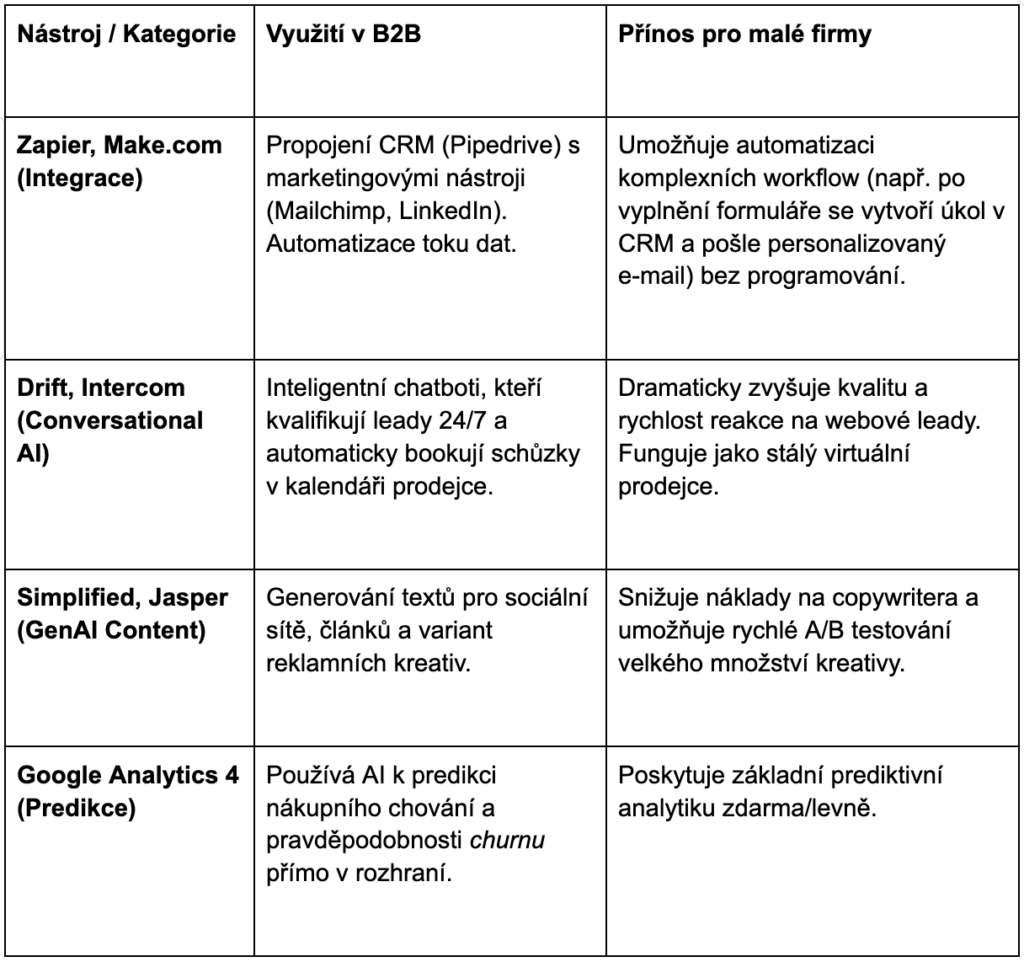
Recommendation: Small and medium-sized B2B firms should start with integration and automation (Zapier/Make) to ensure data flows, and only then deploy GenAI to streamline content creation.
AI and ethics: how to prepare for new rules and regulations
As the power of AI grows, so does the need for regulation, particularly in light of the EU AI Act. Marketers must be prepared for the following by 2026:
- Transparency: Requirements for clearly labelling content generated by AI (e.g. watermarks on images, disclaimers in texts).
- Prohibition of Discrimination and Bias: AI models learn from existing data, which can lead to systemic bias (e.g. AI favouring a certain customer demographic profile, even if another profile has the same LTV). Marketers must audit their AI models and data to ensure fair and non-discriminatory targeting.
- Data Governance: Ensuring that data used to train AI models is lawfully obtained and anonymised, in accordance with the GDPR. B2B companies must be particularly cautious, as they work with more sensitive corporate data.
- Resilience and Reliability: Ensuring that marketing decisions made by AI are explainable (Explainable AI – XAI) and that the AI model does not crash or start generating nonsensical content (hallucinations) at critical stages of the campaign.
Recommendation: Include in the 2026 budget the costs of a legal audit of AI tools and training for the team on ethical guidelines for the use of AI.
Examples of specific AI applications in Czech B2B companies
Czech B2B companies are already actively using AI, often with a focus on data analytics and sales efficiency.
- Example 1: Software Company (SaaS): Uses predictive scoring for Account-Based Marketing (ABM). AI analyses website visitor behaviour in real time and prioritises accounts with a high probability of conversion. Marketing and sales teams then jointly target only the top 5% of the best accounts with hyper-personalised content, rather than a blanket approach.
- Example 2: Industrial and Technology Company: Uses AI to analyse data from enquiry forms. Thanks to a trained AI model, it can automatically categorise incoming enquiries (e.g. ‘Service enquiry’, ‘Enquiry about new product A’, ‘Enquiry about product B’) and forward them to the appropriate sales representative with a predicted time-to-close.
- Example 3: Large Logistics Company: Has implemented Conversational AI on its website for the rapid qualification of B2B clients. The chatbot asks key questions (volume of shipments, destination, type of goods) and generates an instant quote for basic services or passes the contact details to a sales representative in the case of a complex order.
How to get started with AI if your business is just starting out
Entering the world of AI doesn’t have to be a leap into the unknown. Take a systematic approach:
- Data Audit (The Foundation of Everything):
- Objective: Identify where your data is located (CRM, GA4, email marketing, ERP). Is it clean? Is it interconnected?
- Step: Invest in GA4/CRM integration and ensure that all contact and transaction information is in one place.
- Identifying the Biggest Pain Point (Quick Win):
- Objective: Where does your team spend the most time with the least added value? (E.g. writing basic emails, summarising reports, qualifying leads).
- Step: Deploy a simple GenAI tool (e.g. Copilot) to assist with writing, or Conversational AI (a chatbot) for lead qualification. These ‘quick wins’ will demonstrate the value of AI to the team.
- Training and Competencies (The Human Side):
- Objective: Shift the team’s mindset from user to AI manager.
- Step: Invest in Prompt Engineering training for every marketer. Create an internal library of best prompts.
- Progressive Prediction (Strategic AI):
- Objective: Move from descriptive analysis (“What happened?”) to predictive analysis (“What will happen?”).
- Step: Once you have mastered the data, start with predictive scoring (using tools integrated into CRM or GA4) to prioritise sales leads.
Remember: AI is a tool, not a strategy. Start with small, measurable projects that solve a real business problem, and scale up gradually