
HubSpot analysed posts on Twitter, LinkedIn and Facebook. As Facebook is by far the most popular platform in the Czech Republic, we will focus primarily on it.
When is the best time to post on Facebook?
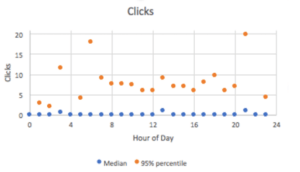
Virtually everyone is on Facebook, so getting into your fans’ newsfeed is a challenge. Hubspot measured click-through statistics
.
Dramatic differences can be seen mainly in the morning and late evening – around 7am and 9pm. From a certain perspective, this makes sense – in the morning over breakfast, many people check to see what’s new. But how many marketers actually post early in the morning?
A bit of maths:
The median (blue dots) is the middle value when values are sorted in ascending order and divided into two equal halves. For example, if we have click values for a post of: 0, 0, 1, 2, 3; the median is 1.
© Hubspot
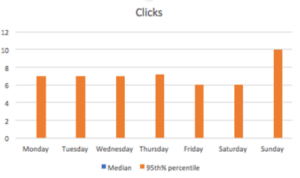
An equally interesting question is: which day is the best? According to the data, it doesn’t really matter. Sunday leads by a few clicks.
© Hubspot
The graph does not show the median for the days of the week. This is because, according to the research, the median is 0. In practice, this means that nobody clicked on thousands of posts. Note that even the percentile results are not particularly impressive.
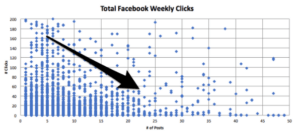
The rule is that if you share 5 or more posts a week, your return on investment drops significantly. However, there are downsides. Many companies have already heard similar advice and are flooding Facebook with nonsense. The algorithm doesn’t know what to display first, and reaching users is harder. It’s like a vicious circle.
The table below shows the relationship between the number of clicks and posts. The graph clearly shows a downward trend – the more you share, the less people click.
© Hubspot
There are a number of reasons for this, not least of which is Facebook’s algorithm. It tries not to overwhelm users. It is possible that some posts simply never make it into the news feed, even if the content is interesting.
How to create a meaningful social media strategy?
According to statistics, it’s best to share no more than 5 times a week. More than that is only advisable in exceptional cases, when you’re racking up likes and comments like there’s no tomorrow. We see this in practice with media pages – in their case, the content is up-to-date and it makes sense to share several posts a day, and all of them will be displayed. It is also important to bear in mind that not all fans see every post.
There is no simple answer to the questions of what time and on which day to post. Our social media specialist Veronika advises carefully testing the habits of your target audience and experimenting: “I would recommend that posts mirror the daily rhythm of your fans. For example, a university student might be online constantly, so the time of day may not matter. But a mother will probably log on in the evening, when she’s finished work and the children are already asleep. Generally speaking, it depends much more on the quality of the content than on the time of day.”
How to analyse the target audience? There are many options. Start with data from Google Analytics and Facebook, then try user testing or a Value Proposition Canvas analysis. Don’t hesitate to ask users directly – you can send them a questionnaire or even give them a call. In such cases, however, try to be considerate so that the research doesn’t inconvenience them.
The quality of the post is key
Users go on social media to have fun; they expect to find information themselves. A high-quality post is one that offers entertainment or genuinely useful information. Users won’t click on anything else. It’s best to avoid misleading descriptions. In this regard, companies have no choice but to be self-critical.
Users may subsequently be disappointed and stop clicking. The same applies to email subject lines. Indeed, Facebook is fighting against this misleading of users and is even stepping up its efforts in this battle. Back in July, it banned the editing of links when sharing, and it is now removing this option from marketers within Facebook Ads as well. There is therefore no choice but to ensure the quality of shared content.
Check how your posts will look after the change. Alternatively, fine-tune your Open Graph meta tags so as not to embarrass yourself.