

Types of usability testing
There are a whole range of methods for testing website usability. As a first step, we can divide these methods into qualitative and quantitative.
Quantitative methods generally involve testing a large number of users. They are usually used to test different variants. An example is A/B testing. This type of testing does not answer the questions of why and how, but rather how many or where.
Google Analytics, or other analytical tools, are often sufficient for testing. A skilled UX specialist can analyse user behaviour from the data. You will learn, for example, which button variant to choose, at what stage of the purchase process customers drop out, what topics interest customers (or rather, what they read and for how long), and so on.
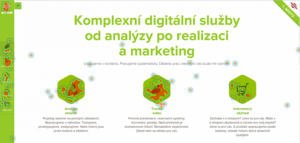
Heat maps are also a popular method – a technique that tracks eye or mouse movements across a page; you can use the free Monkey Tracker tool for this. This is what the output looks like; here you can see which services our clients are most interested in:
Qualitative testing is more time-consuming, but it provides high-quality analysis. It answers questions such as why users do not click to subscribe to the newsletter. There are also a whole range of qualitative testing methods, for example:
-
Focus group – group questioning, which can also be excellent within your company as a brainstorming exercise when developing new websites.
-
In-depth interview – during which we observe the user’s movements on the website towards a predefined goal (such as completing a questionnaire).
-
Card sorting – a method where users assign cards with adjectives (e.g. distinctive, confusing, bland, etc.). You can find a list of all adjectives here.
-
Heuristic testing – a method that involves identifying errors by comparing the current state with predefined rules (heuristics).
There are, of course, many more testing methods; these are simply the ones you can use even in amateur testing. Qualitative testing provides us with soft data – in other words, it tells us what the user thought or how they felt. When shopping, we still make decisions based on feelings and emotions, so this aspect should not be underestimated.
What can I test?
You can test practically anything on a website. Choose the appropriate method depending on what you want to test. If you need to find out what topics interest users on your blog and what to write about, then you need quantitative analysis from Google Analytics.
Do you want to know how the website design affects users? Then try the card sorting method. Do you want to know how users navigate your website and identify any issues they encounter? Opt for an in-depth interview.
You can also use a combination of methods during testing. In-depth interviews and simplified card sorting are very commonly used (for example, using just 30 words instead of an exhaustive list). During the interview, you test the rational aspects, whilst the cards reveal how the user felt.
When should I start testing?
Many people only test the finished project. For them, testing is essentially a final exam to verify that the project is in order. During development, it is better to test right from the start.
Test your initial ideas and wireframes. Start within your company team. Prepare a wireframe and show it to an accountant, for example. Ask what they would expect to find under this button and in this menu section. Test the planned website structure in the same way. Does it seem logical to other people too?
Even in the preparatory phase, you can use user testers. Prepare wireframes for the home page, product pages and contact page. Such testing might take as little as half an hour. Never ask people how they like the design. You won’t get a relevant answer to that question. Ask what information they expect, where they would look for this or that, and so on.
You can test continuously throughout all stages of development, but you can also test websites that have been live for a long time. After all, there’s always room for improvement.
How to start testing: 4 basic steps
- Select the area of investigation
- Select testers
- Prepare a testing scenario
- Testing and evaluation
We will go through all these stages one by one. In the next instalment, we will therefore focus on how to select testers.
This article was originally published on mladypodnikatel.cz