

B2B content marketing remains the driving force behind building trust and generating demand in the B2B sector. However, by 2026, the rules of the game will have changed: the massive rise of generative artificial intelligence (AI) has led to content inflation. The market is flooded with mediocre, rapidly generated content. To succeed, you must shift from quantity to authenticity, depth and the strategic orchestration of content across the entire customer journey.
B2B content marketing in 2026 is becoming the management of an information ecosystem, where the primary emphasis is on credibility (Authority) and effective distribution in places where AI cannot yet reach (communities, dark social).
Why standard blogs and social media are no longer enough
Previously, it was enough to publish SEO-optimised blog articles and share them on LinkedIn. This tactic is ineffective in 2026 for several reasons:
- AI Saturation and Text Devaluation: AI can generate most generic texts (e.g. ‘Introduction to X’) within seconds. Traditional content is thus losing its unique value. Customers can easily spot ‘re-written’ content.
- Loss of Trust in General Channels: Social media algorithms are constantly suppressing the organic reach of corporate pages, and users are tired of promotional messages. Trust is shifting to closed communities, newsletters and private chats (Dark Social).
- The Problem with Demonstrating Authority: In B2B, customers need certainty and proof of expertise to make a purchase. A generic, anonymous blog does not provide this. It is essential to link content to specific faces and data from the company.
Standard blogs and social media are becoming merely distribution channels, not the main source of differentiation.
Content development: from one-off articles to content ecosystems
Instead of dozens of isolated articles, B2B companies must build content ecosystems (Content Hubs) that cover a topic in depth and orchestrate the customer’s journey from initial interest through to conversion.
- Pillar Content: Creating a single, in-depth, data-driven, comprehensive pillar piece (e.g. “The Complete Guide to Transforming Your Warehouse into an AI-Driven Operation”) of 5,000 words. This content clearly demonstrates broad and deep expertise.
- Cluster Content: Smaller, specific articles, videos, infographics and podcasts are created around the pillar, all of which link back to it. E.g. “How to choose a sensor for an AI warehouse”, “Video: Demonstration of X software integration”.
- Purchase Journey Orchestration: Every piece of content in the ecosystem is strategically designed for a specific stage of the purchase cycle (ToFu, MoFu, BoFu) and a specific persona (CFO, CTO, PM). This ensures that marketing always delivers contextually relevant content.
The content ecosystem maximises SEO authority (thanks to a sophisticated internal link structure) and the user journey (guiding the customer seamlessly towards a solution).
Video, podcasts, interactive content – what will perform best
Text-based content remains important for SEO, but multimedia and interactive formats will dominate in 2026 when it comes to building relationships and trust (Demand Generation).
- Video (Short and Long):
- Short video (Social): Used to grab attention and build awareness (ToFu), often utilising AI for rapid generation of variations.
- Long-form video (Expert Hub): Webinars, masterclasses, video interviews with experts, product demos. This is key for MoFu and BoFu. Customers are willing to invest 30 minutes in a video if the content is in-depth and backed by an authority.
- Podcasts (Audio Marketing):
- Perfect for building relationships with a B2B audience that is often on the go (travelling, at the gym). Podcasts enable deeper sales conversations (Thought Leadership) and increase the speaker’s perceived trustworthiness. They are ideal for B2B with a long sales cycle.
- Interactive Content (Conversion):
- ROI calculators, quizzes, benchmarking tools, interactive demos. These elements are the most effective for collecting high-quality data (Intent Data) and driving direct conversions. They provide immediate value to the customer and give the company deep insight into their problem.
Expert Authority: Building the company’s ‘Expert Hub’
In the battle against AI-generated content, human authenticity and professional authority are becoming the most valuable assets. B2B companies must actively build an internal Expert Hub.
- Brand Faces: Every piece of key content (study, pillar article, podcast) must be signed by a specific expert from the company (CEO, CTO, Senior Consultant) with a clear profile and a credible track record.
- Thought Leadership: Content must focus on unique perspectives, predictions, or controversial views that cannot be generated by AI. Customers want to hear your stance on the future of the industry.
- Personal Brand Support: The company must actively support the personal branding of its experts on key platforms (particularly LinkedIn). Content created by an individual has greater organic reach and credibility than content from the company.
Impact: The content marketing budget should include experts’ time spent on content creation and distribution (recording videos, writing comments, participating in discussions).
How AI is changing content: what to automate and what to leave to people
AI is a partner, not a replacement. The key is to define where AI helps with efficiency and where human intervention is necessary for authenticity and trust.
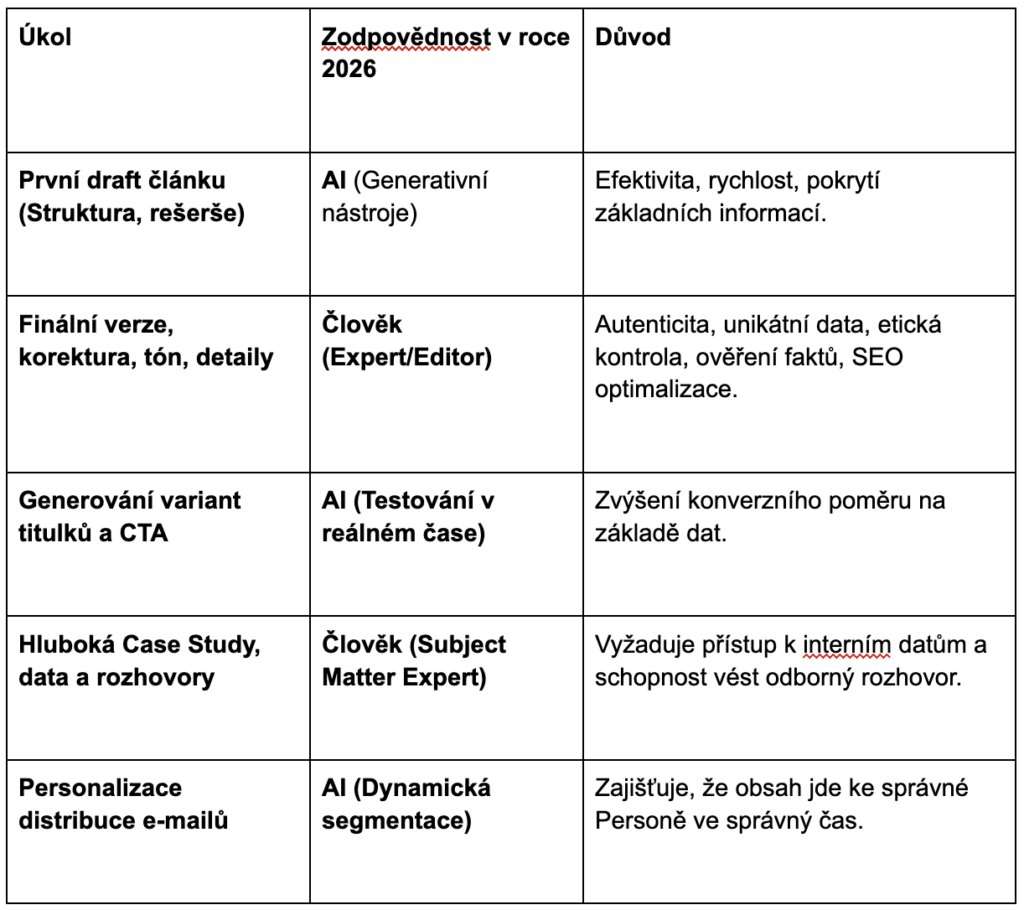
Strategy: Automate 80% of the volume (basic versions, distribution), but invest 80% of your time and budget into the 20% of in-depth content (fact-checking, expertise, tone) that sets you apart.
Distribute content where customers actually are
Having great content isn’t enough; you need to get it to where the buying conversation is taking place – often outside public channels.
- Dark Social (Hidden Communities): Actively monitor Slack groups, Discord channels and private forums where issues in your industry are discussed. Distribute content in a consultative format (i.e. as a response to a query, not as a sales message).
- Sales Enablement: Your sales team is the best distribution channel for BoFu content. Create Content Playbooks that tell salespeople exactly which piece of content (case study, video, calculator) to send to an account at each stage of the sales cycle.
- Targeted Ad Distribution: Use Intent Data and ABM to target paid advertising (particularly on LinkedIn and YouTube) with your key content ONLY at Accounts that AI has identified as in-market.
Key Shift: The distribution budget must be comparable to the creation budget, ideally in a 50:50 ratio.
Content marketing metrics in 2026
Traditional metrics (Pageviews, Shares) are vanity metrics. The metrics of 2026 will focus on interaction quality, authority and revenue.
- Time-on-Content / Completion Rate: Instead of whether they opened the article, measure how deeply they read or listened to it (e.g. Video Completion Rate, Article Scroll Depth). This indicates the quality of engagement.
- MQL to SQL Conversion Rate: Measure what proportion of leads generated from a given piece of content become actual sales leads. (Content has a direct impact on lead quality).
- Brand Authority Score (SEO/SERP): Measure the growth of your SEO authority (e.g. Domain Authority, number of Top 3 positions for key topics) and mentions on external authoritative websites.
- Revenue Influence / LTV: Thanks to CRM integration, track which piece of content played a role in closed deals and what the average LTV is for customers who interacted with it.
How to create an annual content plan for B2B
A successful content plan for 2026 is flexible, data-driven and account-centric.
- Audit and Gap Analysis (Data-First): Analyse which type of content and which topics have historically generated the highest LTV and SQL. Use AI to identify content gaps in the market.
- Defining Pillars and Experts (Authority-First): Select 3–5 key topics (Pillars) that form the core of your expertise. Assign a key expert or company spokesperson to each pillar.
- Buyer Journey Map (Persona-Centric): Create a content map for each pillar: what does the CFO need in ToFu, what does the CTO need in BoFu? Define key conversion goals for each piece of content.
- Agile Planning: Plan 60% of content for the long term (Pillars, in-depth studies), but leave 40% for ad-hoc responses to current trends, news and data signals (e.g. sudden market interest in a specific topic according to Google Trends).
- 50:50 Budget: Ensure that the budget for Content Creation is balanced by the budget for Distribution and Expert Authority.