
B2B lead generation is a perennial business imperative. However, with the growing saturation of content, GDPR restrictions and the increasing sophistication of procurement teams, standard tactics – such as offering generic e-books in exchange for an email address – are becoming less effective and tend to generate quantity rather than quality. By 2026, B2B lead generation will shift from quantity and mass collection to targeted quality, hyper-personalisation and trust-building.
To succeed next year, it is essential to understand that lead generation is evolving into Demand Creation, where the aim is not merely to collect contacts, but primarily to educate the market and build awareness of specific solutions. This article will examine the key shifts that will define a sustainable and high-performing pipeline.
Why lead quality is declining and how the trend will change by 2026
Lead quality is declining primarily for two mutually reinforcing reasons:
- Information Saturation and ‘Lead-Magnet Fatigue’: Customers are inundated with generic lead magnets. They download e-books simply to obtain information, without any real intention to purchase. Many leads are ‘falsely qualified’ – they show interest in the topic, not in the product.
- Sophistication of the Buying Process (Dark Funnel): As already mentioned, B2B customers spend most of the buying process (research, comparison, consultation) anonymously on dark social (e.g. in Slack groups, private discussion forums) or directly with competitors. The customer only becomes visible (generates a lead) once they have a clear idea of the solution, which shortens the time the salesperson has to influence the decision.
Change by 2026: The trend will shift thanks to AI and the Demand Generation approach. Instead of trying to acquire MQLs (Marketing Qualified Leads), companies will focus on identifying PQLs (Product Qualified Leads) and SQLs (Sales Qualified Leads), which are defined by a strong signal of purchase intent (Intent Data), rather than simply downloading an e-book. Quality will improve as we focus on accounts that AI identifies as in-market.
New lead sources: communities, dark social, educational media
Sales teams must move to where their target audience actually is and where real conversations take place.
- Community-Driven Lead Gen:
- Instead of chasing individual leads, companies will focus on building or participating in relevant B2B communities (Slack, Discord, specialist forums). The aim is to establish themselves as a trusted expert who solves problems. Leads are generated when community users themselves ask for a consultation or a referral.
- Problem: This cannot be scaled through mass advertising. It requires human participation and authenticity.
- Dark Social Engagement:
- Although dark social (sharing outside trackable platforms) is anonymous, it can be used to identify pain points and create tailored content. Social listening tools and AI sentiment analysis can identify topics under discussion and the prevailing mood. Marketing then creates targeted content (e.g. video, podcast) and places it where it will be discussed. A lead is only generated when the user themselves comes from dark social to the website seeking a solution.
- Educational Media (Edutainment and Certification):
- Lead magnets are shifting from PDFs to interactive educational platforms, certified webinars or micro-courses. A customer who invests an hour of their time in a certified course about your solution has a higher purchase intent and LTV than someone who downloads a PDF.
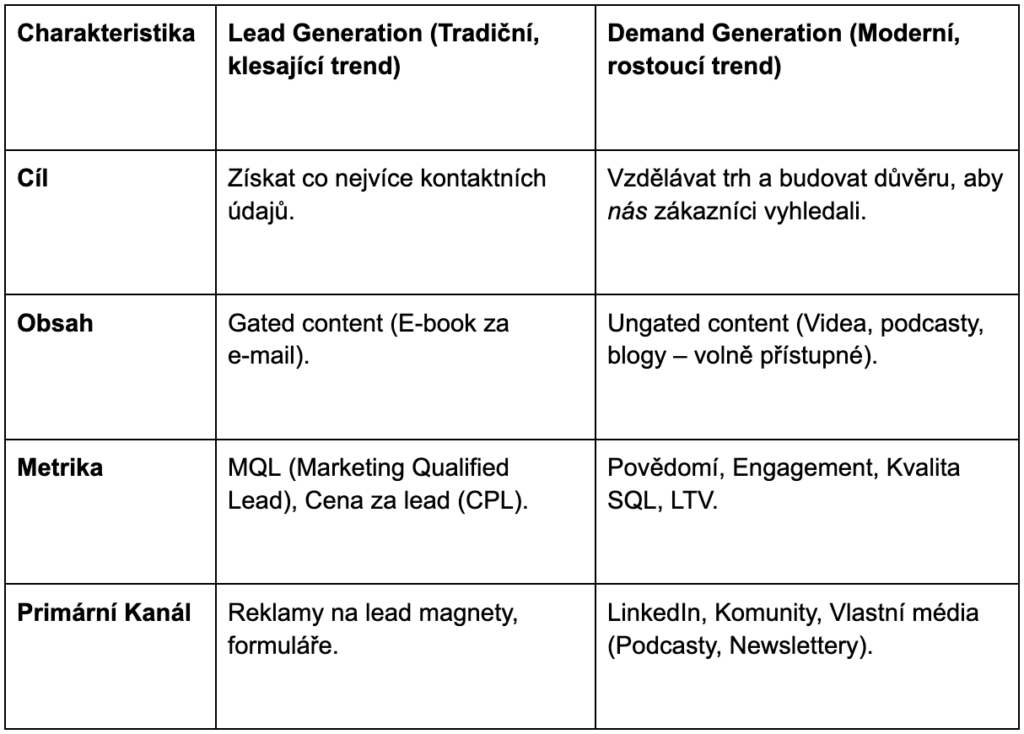
Why Demand Gen in 2026? In an unstable market, trust and awareness are the greatest assets. Demand Gen builds long-term authority (Brand Equity), thereby shortening the sales cycle and increasing the sales win rate, as salespeople are no longer selling to an unknown company but to a recognised partner. Investing in Demand Gen becomes an investment in future cash flow, not just in lead volume.
How to automate lead generation and qualification
In 2026, automation is not just about sending emails, but primarily about fast and accurate qualification, which frees up time for salespeople.
- Conversational AI for Pre-Qualification: AI-powered chatbots conduct qualification calls on the website 24/7. They ask intelligent questions (budget, timeframe, key challenges) and collect data, which they immediately send to the CRM. If the lead meets the criteria (hot lead), the chatbot automatically offers to book a meeting with a sales representative.
- Data Enrichment: As soon as a lead fills in a form, automation tools immediately enrich their data with publicly available company information (size, sector, technology, turnover) using external databases. This provides the sales representative with immediate context.
- Automated Routing: AI automatically routes the lead to the right sales representative (e.g. by region, account size or industry), eliminating delays and errors in the manual process.
The aim is to minimise the time between lead acquisition and its handover as an SQL (Sales Qualified Lead).
The Impact of AI on Lead Scoring and Evaluation
AI is revolutionising how leads are evaluated. Traditional scoring, which only awarded points for actions (clicks 5, downloads 10), is outdated.
- Predictive Scoring (Quality over Action): AI analyses hundreds of data points (including the historical behaviour of successful customers) and assigns a lead a probability of conversion into a paying customer and LTV. This is far more valuable than a simple score.
- Intent Data:
AI scans to determine whether an account is actively in-market
. This includes:
- Web Intent: Repeated visits to key pages (price list, contact details, integration manuals).
- Third-Party Intent: Searches for keywords and competitors on external platforms (often using data tools that collect anonymised signals).
- AI Deal Coaching: After a lead is handed over to sales, the AI monitors communication (e.g. analyses the tone of emails or the mood of a call) and assigns a risk score (e.g. risk of churn or stalling).
Impact: Salespeople do not work with all leads, but only with those that the AI flags as ‘Hot’ (High Probability) and ‘High Value’ (High LTV).
Lead nurturing and smart workflows in 2026
Lead nurturing is shifting from blanket emailing to contextual and dynamic workflows.
- Hyper-personalised nurturing sequences: AI constantly re-segments leads based on their current behaviour (dynamic segmentation). Instead of a fixed sequence (Email 1, Email 2), smart branching is triggered based on what content the lead consumes and what their current challenges are.
- Multichannel Nurturing: Nurturing isn’t limited to email. The smart workflow includes: email $\rightarrow$ retargeting ad on LinkedIn with new content $\rightarrow$ a sales representative leaves a personalised voice message $\rightarrow$ a chatbot offers a meeting. Everything is orchestrated within a single system.
- Sales Enablement Content (BoFu): Nurturing will primarily focus on bottom-of-the-funnel (BoFu) content that salespeople need: case studies with data, transparent price lists, and comparisons with competitors.
Methods that will cease to work (and why)
To maintain budget efficiency, it is necessary to abandon tactics that will not work in 2026.
- Blanket Gated Content (Generic E-books): E-books of the ‘10 tips for [Industry]’ type generate poor-quality leads and lead to saturation. Customers fear email spam and provide false data.
- Cold Outreach without Context (Mass Spam): Mass cold emails and LinkedIn messages without any personalisation or verified context will be ignored, marked as spam and damage the company’s reputation.
- PPC Campaigns Focused Solely on ToFu (Top of Funnel): Pay-per-impression or pay-per-click advertising on very general topics will generate expensive, non-converting traffic. Budget should be redirected towards targeting high-intent keywords and retargeting (where the intent to purchase is clear).
- Inactive Profiles on Dark Social: Having profiles on all social media platforms but not actively participating in conversations and communities is a waste of time. It is better to focus on one or two channels where your target audience is present and actively position yourself as an expert there.
How to create a sustainable pipeline
A sustainable pipeline in 2026 is based on quality and prediction, not volume.
- Measure LTV (Lifetime Value), not CPL (Cost Per Lead): The goal should not be to have a cheap lead, but a lead with the highest predicted LTV. Optimise your budget to generate a smaller volume but with higher profitability.
- Implement an SLA (Service Level Agreement): Set clear rules with sales: What is an SQL? What is the expected AI score? How quickly must the sales representative respond? Monitor SLA compliance, as this prevents the loss of high-quality leads.
- Separate General Content from Nurturing Content: Create ungated content (videos, blogs) for demand generation and brand awareness, and highly gated content (calculators, templates, price lists) only for those who already show clear purchase intent (Intent Data).
- Invest in Technology, Not in Mass Advertising: Allocate part of your budget to data tools, AI scoring and automation (RevOps) that will improve the quality of existing leads, rather than simply increasing your PPC budget across the board.
A sustainable pipeline is one that gives salespeople just enough to enable them to work effectively, and provides them with the tools to become consulting experts, not just salespeople.