

In today’s article, I’ll be discussing the use of advanced analytical methods for analysing customer data. Do you know who your most important customers are, what their customer lifetime value is, which products they’re interested in, and when they last interacted with your business?
We live in a world of ever-increasing data volumes; we collect customer information from many different channels, including physical shops, e-commerce, campaign systems, email marketing, social media, data from merchants, and so on. Advanced analytics are therefore essential – by creating comprehensive customer profiles from this data, you can gain an insight into customer behaviour and thus provide a more personalised experience.
As your business grows, customer segmentation can significantly improve your marketing performance, make your campaigns more relevant to your target audiences, and ultimately increase response rates and sales.
What is RFM analysis?
A common question I hear from business leaders is: “Which of my customers is the most valuable?”. Although this is a relatively simple question with a straightforward answer, there are also advanced ways to answer it. For example, how does a company define a “valuable customer”? It could be customers who spend the most overall, or customers who have a high number of transactions. In addition, there are other considerations, such as the most recent purchase or the average basket size.
Fortunately, we can use RFM analysis – a framework based on recency, frequency and monetary value – which helps us identify a customer’s transaction history and divide the entire customer base into appropriate segments.
What is RFM (Recency – Frequency – Monetary)?
Recency – How much time has passed since the customer’s last purchase? Customers who have recently made a purchase will still have the product on their mind. They are more likely to buy the product again or, conversely, to need it again (for example, with regular orders such as pet food, where we can roughly predict the timing of the next order). Companies often measure recency in days. However, depending on the product, they may measure it in weeks, months or even hours.
Frequency – How often has this customer made a purchase during the given period? Customers who have made a single purchase are more likely to buy again. Furthermore, first-time customers can be a good target for follow-up advertising designed to convert them into more frequent customers.
Monetary (value) – How much money did the customer spend during the given period? Customers who spend a lot of money are more likely to spend money in the future and are of high value to the company. Companies that do not accept direct payments from customers may use any other factors in their analysis. For example, behavioural data from a website or app, where they assess how much they value readers, the number of views or interactions. Instead of the standard nominal transaction value, interaction values can be used to perform an RFM analysis (recency, frequency, engagement).
RFM step by step
1) What data do we need as input for RFM analysis?
For RFM analysis, we will need complete transaction data at the level of a specific order/customer. We typically use input data from CRM systems, or transaction data from e-shops. The dataset must contain the order date, order ID and customer ID, as well as the nominal value of the transactions carried out. I recommend performing the RFM analysis on complete transaction data containing information on purchased products, product purchase prices, product classification, etc. To provide a holistic overview of customer behaviour and subsequently apply the outputs from the RFM analysis, I recommend enriching the transaction data with marketing data (primarily data from email automation tools, web tracking such as Google Analytics, or other attribution tools).
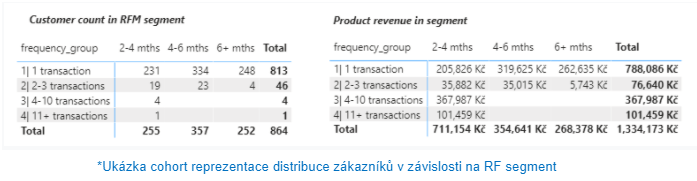
Many companies are only just introducing data democratisation initiatives, in the sense of centralising data sources into a central repository, integrating individual marketing systems, correctly implementing analytical tools, etc. Today’s dynamic digital environment requires regular recalculation of segments and automation of input data to ensure customer classifications remain up to date and for further application across communication channels. Although basic RFM analysis can be performed in Excel, for larger data volumes I recommend using Python or another BI/ETL tool for data transformation and subsequent visualisation in Power BI or Tableau for internal reporting. Most commonly, the outputs of RFM analysis are displayed in a cohort representation, a two-dimensional heatmap in a matrix, or a histogram.
2) Setting rules for customer segments
RFM analysis evaluates customers against each of the three main factors. Typically, a score from 1 to 5 is used, with 5 being the highest. However, different implementations of the RFM analytical framework may use different values or a different scale.
Let’s look at an example:
Customers are assigned a recency score based on the date of their last purchase or the time interval since their last purchase. This score is based on a simple grouping of recency values into a small number of clusters. For example, if you use five categories, customers with the most recent purchase dates receive a recency score of 5, and customers with the oldest purchase dates receive a recency score of 1.
In a similar way, customers are then assigned a frequency ranking, with higher values representing a higher frequency of purchases. For example, in a five-category rating system, customers who shop most frequently receive a frequency rating of 5.
Finally, customers are ranked by monetary value, with the highest values receiving the highest monetary ratings. Continuing with the five-category example, customers who have spent the most receive a monetary rating of 5.
We call the collection of these three values for each customer the combined RFM score. In a simple system, organisations average these values together, then rank customers from highest to lowest to identify the most valuable ones. Some companies, rather than simply averaging these three values, weight them differently. When setting the parameters for customer segmentation, we always take into account the nature of the business and the client’s needs. Personally, I recommend using 5 indices for each customer – R (recency), F (frequency), M (monetary) and the combined RFM score, whereby the combined RFM score is a composite of the individual indices. (When using 5 clusters for R, F, M – the set of results yields up to 125 combinations (5x5x5), the maximum value of the composite index is 555, the minimum 111) final RFM score (average across R, F, M)
At the start of the entire process, it is necessary to set boundaries, thresholds for defining limits. Let us illustrate this with an example:
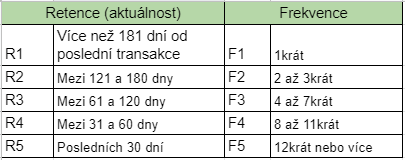
Frequency must always be limited to a time period (for example, the last 12 months). Similarly, segments for the customer’s nominal value are set according to internal logic. Clusters for the customer’s nominal value can be defined statically, or dynamically based on client-defined rules, or the dependency of the order value can be plotted based on the prepared R and F clusters. For each customer, we obtain precisely defined indices here across all different views. I will give a few examples of what the defined segments might look like:
Top customers – this group consists of customers in R-segment-5, F-segment-5 and M-segment-5, meaning that transactions have taken place recently, they shop frequently and spend more than other customers. The abbreviated notation for this segment is 555.
New high-spending customers – this group consists of customers in segments 515 and 514. These are customers who have made only one purchase, but very recently and spent a lot.
Lowest-spending active loyal customers – this group comprises customers in segments 551 and 552 (they have shopped recently and do so frequently, but spend the least).
“Top customer dropouts” – this segment comprises customers in groups 155, 154, 145 and 144 (they traded frequently and spent a lot, but it has been a long time since their last activity)
Based on the resulting RFM scores, RFM segments are defined, which are then applied across the company’s internal reporting.
How can RFM outputs be utilised in practice?
RFM data analysis can help companies with everything from personalising marketing communications for individual customers to identifying and mitigating business risks. Let’s look at a few benefits of using RFM analysis in marketing.
1) Using RFM segmentation in email marketing
Expand your existing mailing database with RFM segmentation and take your email marketing to the next level. This brings us to the point where we can evaluate my earlier mention of the benefits of a holistic dataset for more advanced applications, not just in RFM. Where we have comprehensive web tracking data from an email automation tool at the individual contact level—including information on customer behaviour (emails delivered, open rates, click-throughs, which products they viewed on the website, etc.)—along with complete transaction history converted into RFM segments, targeting our subsequent campaigns is a breeze. In advanced implementations, this information can be enriched with additional metrics from Google Analytics, or other CRM data, to define precise automation rule logic for fully personalised and automated email campaigns.
2) Using RFM segments for lookalike audiences in social media targeting
Using automatic segmentation with RFM, you can automatically define audiences for retargeting on social media. This allows you to continuously expand your audiences with new customers and always target relevant customers based on their CLV and specific interest in products.
3) Advanced RFM for optimisation/strategy using detailed order information
Basic RFM analysis only addresses segmentation at the transaction level, in terms of how often a customer makes a purchase, when they last purchased, and the value of their purchase. For a complete 360° view, it is necessary to delve one level deeper into the actual details of customer transactions. This is one of the greatest challenges of RFM analysis (and segmentation in general): how to create a complete 360° view of the customer.
By knowing the specific products purchased in individual transactions, we are able to identify not only the products purchased, but also the categories from which they were purchased, the purchase price versus the selling price of the products, the proportion of the total order value accounted for by tax, the type of delivery selected, the payment method chosen, and so on.
RFM becomes highly effective when we combine RFM outputs with the results of customer shopping basket analysis. Shopping basket analysis is one of the key techniques used by both large and small players in e-commerce to uncover associations between items. It works by searching for combinations of items that frequently appear together in transactions. In other words, the analysis enables us to identify relationships between items that people buy at the same time, and the categories to which those items belong. As a rule, I calculate these association rules both for specific orders and for all products purchased over the lifetime of a specific customer.
As we have complete information about the order, we are able to precisely define actionable steps for developing business decisions and formulating optimisation strategies – e.g. the impact of discount vouchers on customer creditworthiness. We can also assess profitability = identify shifts within RFM segmentation. The analysis provides detailed insights for creating product sets/bundles as standalone products. Alternatively, it enables decisions on which sets to create within Facebook product collections; how to pair related products within the e-shop; or how to create upsells in the shopping basket, amongst many other scenarios.
The shopping basket analysis is enough for an article in its own right, which I’ll write about another time.
Conclusion
In this article, I’m simply trying to outline the approach; RFM analysis itself is a relatively simple and effective method for customer segmentation, but to ensure it’s fully effective for further decision-making, I recommend always combining it with as much detailed information about your customers as possible. This will make business decisions easier (campaign interactions, preferences, responses, web analytics data, etc.).
RFM segmentation is a proven method for improving conversion rates, profitability and personalised offers. RFM uses entirely historical data to reveal where your business currently stands. The data can be used to predict competitive responses and ongoing changes in purchasing behaviour. By regularly recalculating customer segments, advanced tools enable better predictive analysis and provide an overview of ongoing changes. This allows companies to react more quickly and define plans and forecasts for future business development with greater precision.
If this topic interests you, please get in touch. We are ready to help you grow your data maturity.
Jiří Kohutka – external partner at Aitom Digital
ARE YOU INTERESTED IN WAYS TO BETTER SEGMENT YOUR CUSTOMERS?