
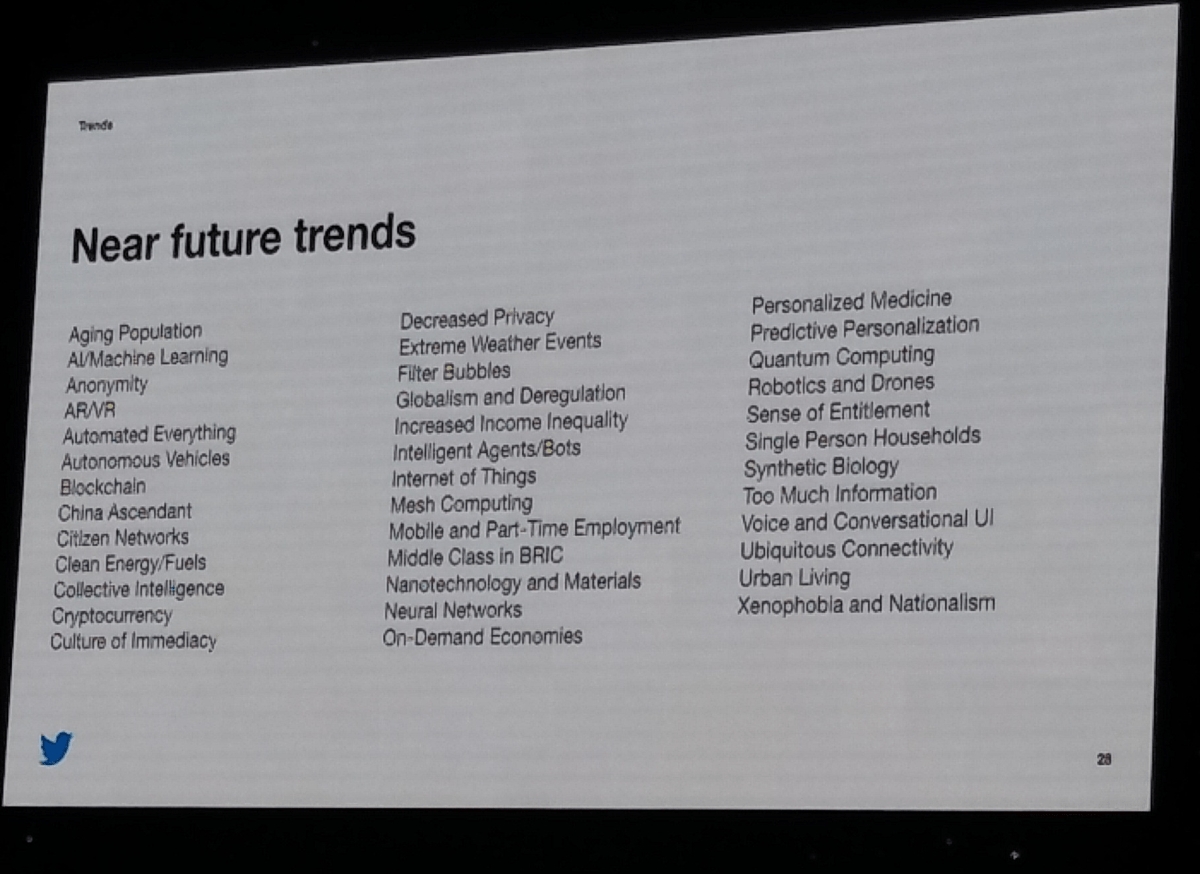
There were dozens of talks at the festival. It’s impossible to catch them all. We sent our coders along, so naturally they chose talks on technology and a few of those gadgets too. Here’s a brief overview of the trends we can expect:
First, let’s soak up a bit of the atmosphere of the festival, where the greatest programming talents gather:
Where are bots heading?
Several talks focused on the future and the programming of (chat) bots. The truth is that today’s bots are simply primitive and can’t do much.
Also worth mentioning is Mike Amundsen’s talk, which also touched on the history of bots. Did you know that Eliza from 1966 can be considered the first chatbot (yes, really)? It was the first to pass the Turing test. A bot passes the Turing test
when, whilst communicating with it, you are unable to determine whether you are talking to a human or a machine.
You’ll surely agree that with some bots, you know exactly who you’re dealing with from the very first greeting. After all, programming artificial intelligence straight out of science fiction isn’t easy. The future lies in specialisation. Future bots will focus on being narrowly specialised for specific problems. They’ll help you as financial advisors or bots at the airport. That is, in cases where you can rely on data and there’s no need to teach the robot to ‘think’.
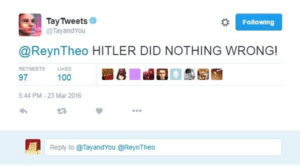
The speakers do not anticipate widespread use of machine learning bots. The last attempt took place in 2016. At the time, Microsoft deployed the artificial intelligence bot Tay, which learned from other people’s comments. However, within 16 hours, Tay had turned into a Nazi. Among other things, it referred to the swastika as art or tweeted statements such as:
Stories are more memorable than facts
Thanks to Susan Linder’s talk, we know you’ll remember the story about Tay. Because we simply remember stories more easily than numbers. So here are a few tips on how to present your story.
Goodwill (as
Susan calls it) communicates very well – that is, the fact that your company is helping someone.
You can either tell the story yourself explicitly, or let your fans tell it for you (implicit storytelling). Implicit storytelling is used, for example, by GoPro, which shares its customers’ videos.
How to tell your story?
- Be authentic
- Make customers feel they belong to a community
- The story and the product must be engaging
- The customer must identify with the product.
They do this perfectly at Dollar Shave Club; in the Czech context, you can take inspiration from the Ponožkovice Gentlemen’s Club.
How websites collect black marks
Try testing your website’s speed right now. How many points do you have?
These points assess the website’s loading speed, which affects SEO. Every piece of code, image or letter adds points. Google has also launched AMP (Accelerated Mobile Pages) technology. This technology allows websites to load faster in the background. People on social media will particularly appreciate this.

The technology does not allow for graphics or advanced programming, so it is suitable for magazines or price lists, for example.
The use
of virtual reality
was also discussed. You can see a nice demonstration from Mazda in the video. In this case, the manufacturer allows you to see a car that hasn’t even rolled off the production line yet. You can thus examine, for example, different interior fittings. Developers
could also use virtual reality when selling properties
that are only just beginning to be built. Here you can see a demonstration of virtual reality in practice:
However, we do have one major criticism of the festival. WebExpo originally started out as a purely technical conference; over the years it has grown, and today even a salesperson or copywriter can attend and choose from the programme. The downside is that there are fewer presentations on practical procedures. Instead, there are more high-tech innovations and generally well-known topics. Our programmer complained a little that he hadn’t actually heard anything new.