

1. Have an exit plan
What happens if you want to end your partnership with the agency? Even if they are lovely people who provide top-notch services, the partnership may still come to an end.
Remember that the website code is yours and yours alone. Under Czech law, you do not hold the copyright to the code. The contract should clearly state that if you terminate the partnership, the agency must hand over the code to you in full and you have the right to dispose of it as you see fit.
In the Czech context, there is no specific legislation on this matter, and agencies often refuse to hand over the code. Sometimes this is because they fear for their know-how, and sometimes because they want to make your departure more difficult and thus retain clients. Ask for guarantees right from the start.
This applies not only to website code, but also to marketing tools such as Sklik, AdWords, Analytics and others.
2. Use the web provider’s hosting
The agency building your website should also offer hosting on their server. Why? Because if ‘something breaks’ on the website, you know exactly who is responsible – your agency.
The server doesn’t necessarily have to be physically located at the agency’s premises – for example, we have servers in Prague 3, but our office is in Michle; the agency needs virtual access. Many clients hesitate to move their website to another server because it seems more expensive. But savings can be a double-edged sword.
For example, at AITOM, we look after a client’s website who, to save money, kept the site on their own server somewhere in Prague. An error appeared on the website. The client asked us to fix it. That wouldn’t have been a problem, of course; that’s what we’re here for. However, the fault was on the server, not in the website’s code. It took us 14 days to find out who manages the server and gain access – for an error that took 20 minutes to resolve.
As a result, the client was losing conversions and loyal customers, and lost far more money. And we know for certain that it added a few wrinkles to his face.

3. Back up, back up, back up
What happens if your server room catches fire? Or if a burst pipe causes a short circuit and you lose all your data? You must have a backup ready. You need to back up all data – code, content changes, and the client or order database.
Backups should be sent to a different data centre. So if your cat chews through the cables or water floods the server room, you can immediately ‘restore the backup’ and carry on with your business without missing a beat.
Define the frequency of backups in your contract. AITOM, for example, saves changes to backups daily; we keep a backup from each day stored for 14 days just in case (or longer, depending on the agreement with the client). Such a backup is sufficient in the vast majority of cases; backups older than six months serve no purpose at all for most projects.
4. Ensure you have technical support in place
What happens if you want to add a new form? Or, conversely, if the old one breaks? Naturally, you will arrange for some form of technical support. Agencies that build websites will likely offer this to you automatically at a discounted rate. Consider the extent to which you need expert help from developers, and what you are able to manage on your own.
Pay attention to the server uptime figure. This will be stated in the contract, or in the binding technical specifications of the web application you are ordering. It is usually given as a percentage. The figure looks something like this. Downtime is calculated in hours over the course of a year. If the provider does not guarantee server uptime, you are usually entitled to a discount or similar compensation.
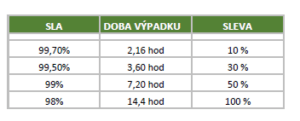
No one can guarantee 100% server availability. Even large e-commerce sites such as Amazon only have 99.9% availability. Why? Because the server needs to be maintained; sometimes you have to restart it, and so on. This is particularly noticeable with banks. Has your bank ever written to you to say that online banking would be unavailable? Probably at some point during the night? This was most likely due to server maintenance.
The 99.7% figure specifically accounts for maintenance; these are pre-planned outages. It does not include errors or, for example, the aforementioned server failures. Consider carefully what you actually need. The higher the availability, the more expensive the service. For example, 98% availability is more than sufficient for a small e-shop or a brand website.
Also define the application’s availability in the contract, known as the SLA. This is not usually included in contracts. It may happen that the site, to put it simply, ‘crashes’ because a query gets stuck in a loop, traffic spikes due to a campaign, and so on. The site may not be prepared for this. The SLA specifies the response time within which the agency must resolve the issue. The price of the service then increases according to the response time. If you have defined application availability in the contract, the agency must resolve any problem within the specified time.

5. Plan your website migration
Are you planning a new website? And have your marketers prepared for the migration? Your PPC links certainly lead somewhere. Do you already know how you’ll redirect all your advertising? Not to mention that your old site has a history that affects SEO.
Many clients forget this. Yet it is absolutely crucial. The agency should make the effort to ask you, or even handle the entire migration, to ensure that SEO and PPC aren’t affected.
6. Look for a comprehensive solution
For these reasons, look for a comprehensive solution. Having a server in Vienna, a coder in Prague and a copywriter in South Moravia may be cheap, but it’s highly inefficient and difficult to coordinate.
Very few agencies take a comprehensive approach to their work. Your agency doesn’t need to have all specialists in-house, but it must be able to offer you a solution. After all, their job is to build websites. Your job is to focus on your customers.
7. Ask about after-sales support
It’s not enough just to develop and launch a website. Sooner or later, something will need to be changed or adjusted. Ask the agency straight away whether they provide additional support and at what extra cost. Ideally, ask for a quote for three typical modifications that might be required – for example, creating a new landing page, changing a graphic element, or creating a new form. In every sector, these hypothetical modifications will look slightly different.
Consider the scope of support before choosing an agency. It is possible that an offer may seem more advantageous at first glance, but once you factor in the follow-up service, it becomes much more expensive.