

Purchasing is driven by emotions
Economic theory operates on the basis of the so-called rational consumer – that is, a customer who makes decisions to maximise their profit. That is the theory; in practice, the rational consumer does not exist
, at least according to Filip Kahoun
. Consumers always make decisions online based on emotions and feelings.
The following emotions determine brand choice:
- Pleasure
- Trust
- Status
- Responsibility
- Efficiency
- Individuality
- Savings
- Belonging
8 emotions determine brand choice. Do you know what they are? @FilipKahoun at #copycampH1 pic.twitter.com/aJGXbYIe6C
— eVisions.cz (@eVisionscz) 8 June 2016
That’s all well and good, we’ve all heard this before. That’s why we’re all working on some sort of brand image, after all. The problem is that internet users are fundamentally not guided by facts, but by the feelings those facts evoke in them. Bear in mind what associations you want to evoke. Incidentally, speaking of emotions, the most successful song of all time is ‘Happy Birthday’ – yes, that very cheesy birthday song.
How to do user-friendly SEO
Internet users are not only emotional creatures, but also very lazy. Pavel Ungr and Jan Kvasnička therefore advised us on how to serve them the information they need. Don’t count on users finding anything for themselves; guide them instead.
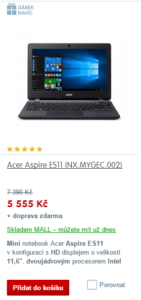
For example, in an e-shop, give the customer precise information. In the case of an e-shop, they’re always interested in when they’ll have the item at home, not how your stock management works. This small adjustment will positively impact your e-shop’s conversion rate.

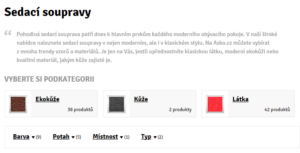
The same applies to copy. Many online shops write descriptions for their categories. Let’s face it: nobody reads category descriptions. If you can’t say anything new in them, don’t say anything at all. You certainly won’t impress a customer with the information that a sofa is the main feature of a living room.
“SEO for SEO’s sake is nonsense. We don’t write copy for search engines; they don’t shop with us.” @PavelUngr at #copycampH1
— Markething.cz (@Markethingcz) 8 June 2016
We’ve already written about how people don’t read on the internet these days, they just scan. Write all your text so that it’s easy to scan. You need headings, bullet points or numbered lists, the occasional infographic, links and bold sections of text. It never makes sense to bold a keyword. Why? Your customer already knows that; they won’t be looking for it in the text.
Search and content on the internet are meant to serve people. That is why Google develops algorithms that behave like a user. Generally speaking, what the user doesn’t see at first glance, the search engine algorithm doesn’t see either. Hidden text is therefore invisible to search engines, and they don’t want to see it.
Become your customer’s best friend
Let’s return for a moment to the fact that customers are emotional rather than rational beings. They need to feel comfortable on the website, and the site must be tailored to this. That is why you should test all elements using A/B testing. Perhaps your customers will prefer a different type of form, like different buttons better, or respond to other ‘call-to-action’ options.
It works very well if you tell customers what to do. Do you have a helpline? Let customers know when they can call you. Provide hints in the full-text search as to what can be found; few customers will think to enter, for example, an order number or the EAN code of the product they are looking for.
Be personal in your communication, because it is precisely through communication that the customer must feel at ease. Consider a creative email address instead of the standard info@mujweb.cz. For example, we use radbych@aitom.cz, and the Bonami e-shop uses sluzebnicek@bonami.cz. But be careful: make sure you also have info@mujweb.cz. Why? Customers are used to it and might write to it out of habit.
Consider what customers expect and communicate with them accordingly. The Czech Olympic Committee has adopted precisely this tactic. It stopped simply presenting results and opted for a much more authentic approach, giving sports fans a glimpse behind the scenes of the Games. Compare the Facebook figures for the Czech Republic (302,000 fans) and the USA (3,175,000 fans). In both cases, the admins wished a well-known athlete a happy birthday:
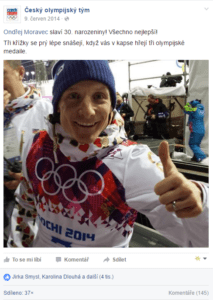
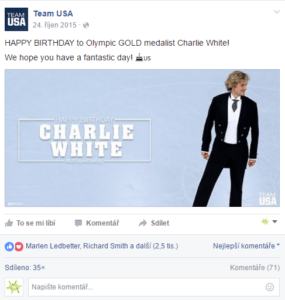
It is quite clear that authenticity wins out. Don’t be afraid to use blurry photos taken on a mobile phone, as long as they are distinctive.
Photo sources used: www.mall.cz, ww.alza.cz, www.asko.cz, Czech Olympic Committee, US Olympic Committee.