
The book’s author is coder Martin Michálek, which rather alarmed part of our sales team, whilst the lads from the development team were chuckling behind their backs. But don’t let that put you off. The first part of the book is general in nature; the second part is where the technical side of things comes into play. Even a layman who vaguely understands that the abbreviations CSS and HTML weren’t created by a random letter generator will find something of interest here. We’ll skip over the technical sections of the book in this review.
Martin Michálek also writes a blog, www.vzhurudolu.cz, which is full of up-to-date articles. On this website, you’ll also find excerpts from the book and can download it straight to your e-reader.

Diving into the world of mobile devices, or what to do with large screens
In the first chapter, you’ll discover why we need to talk about responsive design at all
. We’re faced with two extremes here: super-large monitors on the one hand and relatively tiny mobiles on the other. And the spoilt user demands that it works nicely on both.
If you’ve been reading our blog for a while, the graphs showing the rise in mobile traffic will likely be a refresher for you. On the other hand, it’s good to be reminded of them, because as our primary school teacher used to say: repetition is the mother of wisdom
.
However, the teacher forgot to add that wisdom lies in perspective, so Michálek adds this for her in his book. He warns that you shouldn’t forget the larger devices in your pursuit of ‘mobile first
’. Google, in fact, recommends that a website should work on a single URL
for all devices.
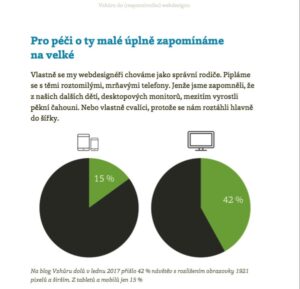
The basic rule is: a responsive website works on a home cinema system as well as on a mobile
At this stage,
the technically savvy will appreciate the chapter on typography and defining font sizes using the rem
variable, or the section on why and how to use images in SVG
vector format.
There are various approaches to adapting a website
– including the m.domain.cz variant; this so-called mobile version
is then intended solely for small screens. However, Michálek would not recommend it (and, incidentally, we do not develop websites in this way either).
“M-dot websites can be a good temporary solution. However, only responsive websites are sustainable in the long term.”
User-centred design is essential reading for everyone
The web design process (let’s really just count design, not development) is a demanding and complex process
. Long gone are the days when one person could handle this. Today you need a graphic designer, a UX specialist, a copywriter, analysts, and a secretary to brew litres of coffee for everyone mentioned.
Let’s assume everyone understands that what matters is the user’s interest, not simply
“making the website look nice
”. If not, add a mediator to the list of people. This approach is called Human-Centred Design
(note: human, not user. The essence of the matter is to perceive people as people, not as items in analytical tools). You can find an excellent course on Human-Centred Design at Seduo.cz
.
Michálek recommends researching users using the User-Centred Design Canvas method.
“Larger projects tend to produce more outputs during the research phase (…). However, the User-Centred Design Canvas is a tool that can summarise them all on a single page. For larger projects
,
the UCD Canvas can serve as a summary guiding all team members through the project. For smaller projects
,
we can manage without further outputs.”
The Canvas looks like this and truly summarises the most essential aspects of the analysis:
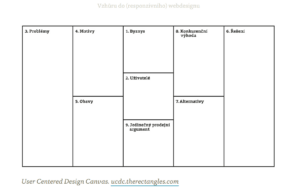
You can find out how to work with such a template here.
Thanks to the book, we also realised how important it is for the coder to be involved right from the website design stage, as otherwise the design may not align with technical capabilities. As an alternative, he suggests an approach where the main tools are pen and paper. The author admits that this method isn’t suitable for agencies, but he certainly offered us a more critical perspective on our own work.
If you’re struggling to visualise this from the description, the template and process are illustrated with an example.
Set in stone: Graphics may be pleasing, but they must serve a purpose
One common mistake is to create websites that are merely attractive and captivating. Graphics must serve a purpose, which is usually to generate enquiries or sell a product.
That’s why you need a designer who knows what they’re working with. Web design has its own specific requirements. The most common mistake is typography – that is, the typeface. Because a beautiful design catches the eye, no doubt, but only legible text sells.
Our verdict on the book
We liked the book, although some of us did skip the technical sections. Martin Michálek has put together an admirable collection of facts, recommendations and examples of how (not) to design websites. There is little technical jargon in the book; the whole subject is explained quite simply.
At the end of each chapter, you’ll find a summary and, above all, tips on which other books and resources are worth reading. We give this a huge thumbs up.