

What is usability testing?
It is a method that allows you to identify and fix errors that make it difficult for users to navigate your website. You’ve no doubt heard of UX; it’s something of a mantra for all web designers and online specialists. It stands for User Experience. With an endless number of websites out there, if you want users to stay on yours, they need to find it engaging and easy to navigate.
DOES MY WEBSITE HAVE ERRORS TOO?
Steve Krug, author of a whole series of books on web design and usability testing, compares user testing to a group of tourists visiting your town. When you’re showing tourists around, you’ll notice things you normally overlook. Simply because visitors force you to look at your town or website from a different perspective. They will also show you that what seems completely obvious to you can be an unsolvable puzzle for others. A different perspective is exactly what you need, which is why even simple amateur testing works.
Answers to the question ‘why?’
User testing will answer the question of why users do not complete the entire conversion process. Even if it seems trivially simple to you, your users may see it differently.
Take, for example, the website of a timber-frame builder. At first glance, users liked the site, but after using it for a while, at least half said the site was confusing and that they would leave without making a purchase or enquiring about a service. Why? There are effectively three menus on the site. Put simply: they didn’t know where to click first, so they got lost in the website’s structure. User testing will reveal such errors and allow you to fix them very easily.

Anyone can carry out testing: as few as three users are enough
In-depth interviews are the most common method used in website testing. You might not even be aware of this. A very simplified version of this test is a situation you’re no doubt familiar with: you’ve designed a new website layout or a new product, and you go to your wife, a friend or a colleague and ask, “What do you think of this?”. An in-depth interview has a somewhat more complex structure, but the principle is quite similar.
Usually, at various stages of website development, you approach several people for testing. You prepare a set of questions you want to go through, and for about an hour with each person, you browse the website together, noting where they get lost, what they don’t like, and so on. As few as three users are enough for the results to be relevant.
Excuses for why not everyone tests
-
It’s expensive
On the other hand, losing users because they can’t find the delivery terms on your site is also expensive. What’s more, you can carry out a basic test yourself; it only costs you time and, if necessary, a small reward for the testers.
-
It won’t do me any good
Users will find their way around the site more easily. They’ll enjoy the content more and generally prefer spending time on your site.
-
I know what my users want
That’s what the construction firm in the first image thought too, but unfortunately the users saw it differently. Sometimes even the smallest things can put users off. What’s more, they’ll always uncover some problem you had no idea could even be there.
-
It’s time-consuming
Yes, that’s true, but so is developing an e-shop, and you certainly don’t want to develop an e-shop unnecessarily. The time you invest in user testing will definitely pay off. If you don’t want to invest your own time, hire an agency.
-
I don’t want anyone meddling in my work
None of us likes being told about our mistakes. But two heads are better than one, as you know. Users might come across little things that put them off, and you haven’t even noticed them. A good example is the construction company’s website below, which offered a catalogue of houses to download on practically every page. It wasn’t a bad idea, but users interpreted it as being pushy and were dissatisfied.
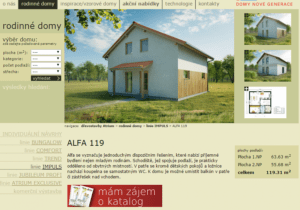
Bear in mind that most websites haven’t been tested by users at all. Consequently, users find navigating them difficult and clunky. User testing and subsequent website optimisation are, above all, a significant competitive advantage.
We’ll show you how to test your website yourself at minimal cost. Bear in mind, however, that an amateur test is always just a small, initial probe into usability issues. If you consult professionals, testing will always be more effective and accurate. It’s the same as with the examples of construction firms in the article. You certainly wouldn’t build a house yourself. We certainly wouldn’t – we can’t even build a house of cards.
In the next instalment, we’ll focus on what can be tested and how to plan a test.
This article was originally published on mladypodnikatel.cz