
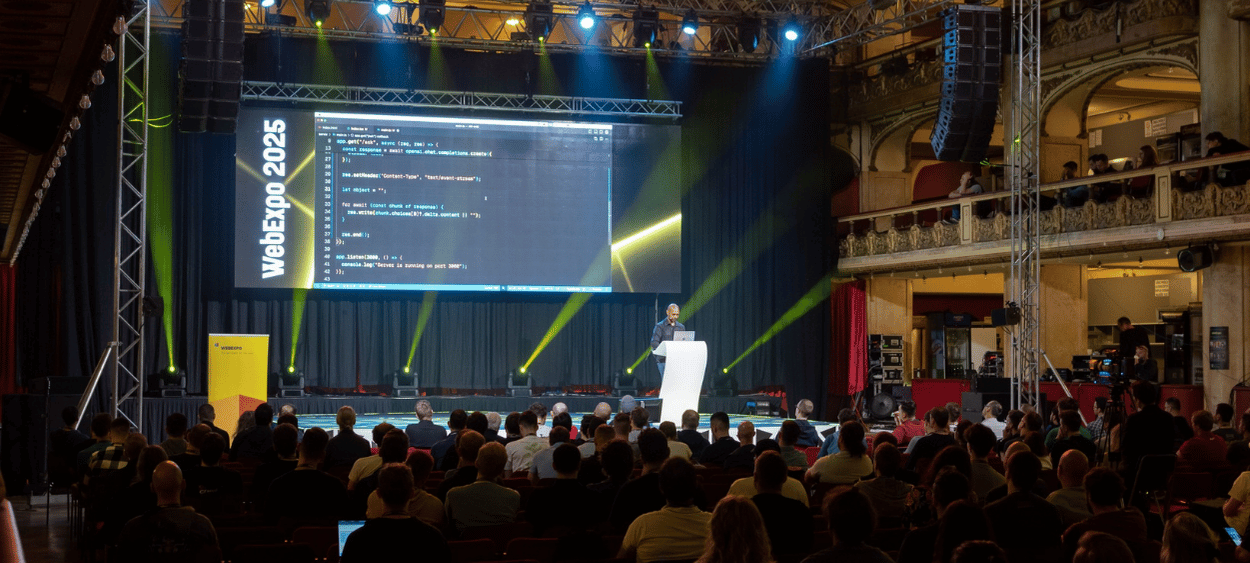
We sent our programmers, a coder and a consultant to the event to broaden their knowledge of the latest technological developments.
A packed programme awaited them over the two days – they had the chance to hear 80 speakers from the Czech Republic and around the world, experts in coding, web design, UX and management. The entire conference took place simultaneously across four halls at Lucerna in Prague.
What caught the attention of the individual AITOM team members the most?
Pavel Quaiser, online solutions consultant:
I was struck by the description of the difference between a website enquiry and a website brief. As a consultant, I deal with this on a daily basis when people ask about prices.
© Presentation by Jan Řežáč and Jan Kvasnička | WebExpo
A typical enquiry might be: “I’m interested in a simple, modern website with a responsive design and attractive graphics, comprising 25 pages – could you send me a quote?” I can design such a website for 100,000 or for 800,000, and both websites can fulfil their objectives. That’s why we need a more detailed brief, including a wireframe, structure, keywords, a definition of the target audience and the website’s objectives.
I regularly remind clients of this, and I’m glad we’re not alone in this. I think the talk has broadened my perspective and I’ll be able to explain this to clients more effectively. You can find the full talk by Jan Řezáč and Honza Kvasnička on how not to build websites, delivered with a qualified view from the window, here. They also discuss how not to commission projects and how dangerous ‘domain-nameology’ is.
This lecture was the most beneficial for me. It confirmed that we are doing meaningful work. At AITOM, we always analyse first and ask what the website is supposed to achieve before we start developing. We prepare detailed briefs for clients based on data. I definitely recommend everyone watches the lecture. Incidentally, ‘doměnkologie’ is a new term that amused us all, as it is absolutely spot on.
Petr Pouchlý gave another interesting talk. As an expert in gamification, he spoke about how to draw users into the game. For 40 minutes, he discussed onboarding – that is, the process of onboarding and adapting an employee, or indeed a software user.
For me, this talk was closely linked to the talk by Jan Řezáč and Jan Kvasnička. It is simply essential to design a solution that is user-friendly and, ideally, entertaining too. The key idea was that it is necessary to map user behaviour from both a practical and emotional perspective – whether they will be motivated or frustrated. We will now be thinking about how to implement this within our reporting system – which, whilst simple, is essentially boring.
For me, the be-all and end-all of the whole lecture was this:
© Presentation by Petr Pouchlý | WebExpo
Radim Hašek, programmer
Most of the talks I attended were interesting and inspiring. Some discussed technologies we are already using in practice, whilst others covered technologies we are considering for the future.
There was a lot of talk about architecture using microservices, and at Jiří Riedl’s talk on Microservices Architecture, I learnt more about the practical implications of switching to this architecture.
Martin Bohal’s talk on ‘PHP, PSR-7’ was also very informative, as he gave a fairly in-depth demonstration of the new standard for PHP, which will soon be used in all PHP frameworks. As every year, Ondřej Žára gave a precise talk on the latest developments in JavaScript, specifically the ES2017 standard. The talks on marketing were also beneficial
. In his talk on marketing automation, Jan Kalianko demonstrated how automation and elements of artificial intelligence can be utilised in marketing.
And I tried out virtual reality – let’s admit it, for a tech enthusiast, that was probably the most interesting experience 🙂
Michal Kopecký, junior programmer, and Michal Fryč, coder
We were most interested in the two talks on web accessibility. Accessibility is a major topic, and there are even methodological guidelines for accessibility for users with disabilities. The talks inspired us to work better from a technical perspective. In future, we also want to think more about accessibility during development. Our professions as coders and programmers complement each other perfectly in this regard.
We realised that an accessible website isn’t just one designed for the blind, but one that is user-friendly for everyone. Let’s face it, there are far more colour-blind or severely short-sighted users than blind ones. And it is possible to cater to everyone.
We were struck by the fact that relatively little is needed – for example, setting a sufficiently large font size or configuring keyboard shortcuts. The section on how to technically implement button functions was particularly interesting. As an example of an accessible app for the blind, you could try the Czech Railways’ ‘Můj vlak’ app. Practical tip: you can check the accessibility of your website.
You can find a recording of Radek Pavlíček’s lecture here; the practical demonstrations were presented by Martin Michálek and can be found here.