
The index is essentially nothing more than a vast catalogue of all websites and web pages. Google uses it to organise information from the internet so that it can offer you the most useful search results. The size of Google’s index exceeds 100,000,000 GB; see its indexing page.
Until now, Google has viewed websites through the eyes of desktop users. Even if you searched on your mobile, Google would show you results leading to websites that weren’t optimised for mobile devices. This ranking will change. Priority will be given to websites that are optimised for mobile devices. Ensuring your website displays correctly on mobile will be more important than ever.
Index rollout expected in 2018
In November 2016, Google announced that a new mobile-first index would be created. It immediately began testing the new index. This is in response to the ever-increasing number of searches from mobile devices. Until now, website responsiveness has been just one of the ranking criteria used to order results. The mobile-first index should change that.
“75% of search in 2017 will be mobile …” #StateofSearch #SEM #SEO @wonderwall7 pic.twitter.com/IqRvTM164I
— Rogue Marketing (@roguethink) 14 November 2016
Google will first check the mobile version of a website; if no such version exists, it will only then examine the desktop version.
Google analyst Gary Illyes expects the mobile index to go live in 2018. Google is currently working out how the index will operate so as not to penalise websites that do not have a mobile version.
Redesign dedicated mobile domains
The mobile-first index should primarily address websites that have a separate mobile version. Some websites have a mobile version on a domain such as m.web.cz, which often features different content from the more comprehensive desktop version. Gary Illyes says that responsive websites are well prepared for the new index and such websites should not be significantly affected by it.
A mobile version of a website on its own domain, such as m.your-website.cz, has its advantages. For example, it is significantly easier to develop, as the developer does not have to worry about responsiveness and display on two completely different screens. However, Google has encountered a problem here with differing content. There is less mobile content, it lacks internal linking, content duplication occurs, and so on.
This is why Google advises developers to convert domains such as m.vas-web.cz to a responsive design before Google rolls out the new index.
Currently, Google primarily uses the desktop version as a reference. In the case of m.web.cz domains – intended for mobile devices – it therefore does not index the content correctly.
Mobile content should be comprehensive
Mobile content should match the desktop version. Less content may result in a lower ranking in the mobile-first index.
Once again, responsive websites have the advantage, as they offer users the same content across all devices. In other words, content that is comprehensive for the user. Google operates on the assumption that users expect the same information service on all their devices.
The mobile pages should be fully equivalent in content & functionality regardless of indexing, right? Why wait to fix that? Users care too.
— John ☆.o(≧▽≦)o.☆ (@JohnMu) 19 June 2017
What should you check?
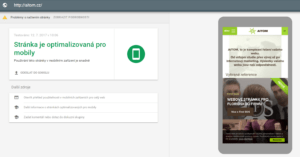
- Check whether your website is responsive. Google offers a test for this. Test your responsiveness
- Next, verify that Google is indexing your pages correctly.
Enter this phrase in the search bar (on your smartphone): “site:yourwebsite.cz.” In our case, Google is indexing the pages correctly (i.e. displaying them in search results).