
Do you know your target audience?
You create your website for your customers. Is that right? Do you think that goes without saying? Very often, we come across the problem with clients that they haven’t defined their target audience at all, or only very superficially. It’s impossible to create a user-friendly website for an anonymous user. After all, a teenager behaves differently from a mother of a young child and a senior manager who spends all their free time playing golf.
Do you have a defined target audience? Excellent. Ideally, write your definition down on paper; you’ll use this definition to find suitable testers. Don’t have a clear idea of who you want to sell to? Then we need to change that.
The persona as a customer prototype
Have we heard of personas before? It’s an excellent way to get to know your target audience. A persona is essentially a simple customer profile. It includes their age, gender, place of residence, approximate income, interests and challenges. Give the persona a face too; it will help you better empathise with their needs and perception of the product.
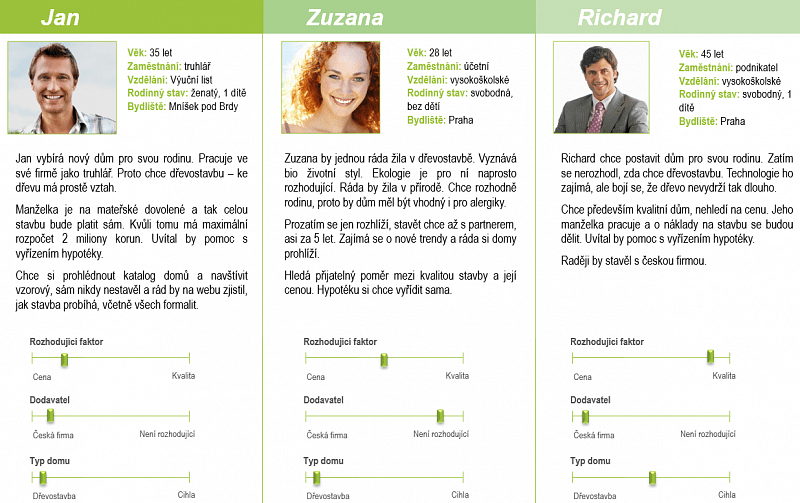
The aim is to create a model personality that will help you put yourself in the customer’s shoes. We usually create several personas, depending on the needs users have. Don’t create more than five; instead, try to simplify customer segmentation using personas. For example, what do the three basic personas look like for a company that builds wooden family homes:
For basic persona creation, it is sufficient to think carefully about users’ needs. Advanced analysis must be based on the data you have. Google Analytics will tell you who your users are (their age, gender, place of residence). You can run a survey on your website or commission market research. You’ll find an excellent guide on how to proceed on Roman Hřebecký’s blog. You can create personas yourself with ease. Download our template and give it a go!
How to choose suitable testers?
Select a few testers from your target group. Choose them so that they represent different user problems. Let’s stick with the example of timber-frame houses – choose a user who wants to build immediately; a user who is just exploring the market and isn’t planning to build just yet; and then someone who already has a house. The latter will give you valuable feedback on what they had to deal with during construction. You can resolve these issues in advance. It is best to have a mix of ages; include both women and men – as they have completely different perspectives.
Sometimes less is more. For an amateur test, selecting 3–6 testers is sufficient. It depends on how many staff you have. Just 5 testers can uncover 75% of major usability issues.

You can approach users directly from among your customers, place a banner on your website or social media inviting users to take part in testing, or ask a recruitment agency to help with recruitment.
However, always screen your testers. You could, for example, send them a short questionnaire and, based on their answers, select the testers you need. Get in touch with each tester. Arrange a meeting with each one individually; even such a small gesture can help you establish a personal connection.
What’s in it for them?
It may be that testers are willing to help you just for the sake of it. But most of them will be pleased with a small gift. They’ll praise you to their friends and you’ll get free advertising. If you have a lovebrand or attractive products, you can give users a gift. An alternative is a gift voucher of a certain value, or financial compensation.
Get creative – are you testing a new website for selling luxury cars such as Ferraris, Lamborghinis or Rolls-Royces? Offer a free weekend car hire as a reward. Do you sell fashionable hats? Perhaps your customers would enjoy a millinery workshop and the chance to make their own hat. You already know your target audience, so choose something they’ll enjoy.
How expensive should the gift be, or how much should the tester receive? Again, base your decision on the target group. Usually, the value of the reward is in the region of a few hundred crowns. They’ll spend at least an hour with you, plus travel time. So offer them at least as much as they could earn in two hours.
This article was originally published on mladypodnikatel.cz