
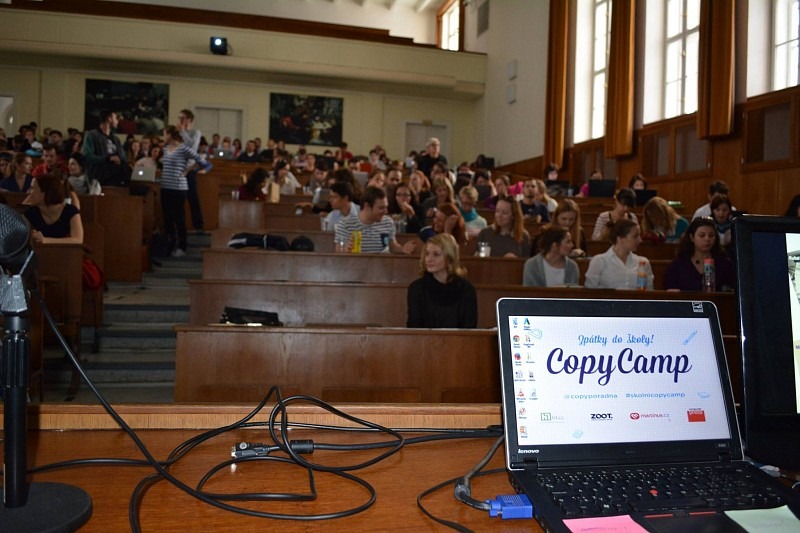
All copywriters and online writers returned to the classroom for a day at the Faculty of Arts, Charles University. The whole day was spent discussing how to write better, how to build a brand, how to evaluate texts, and many other topics.
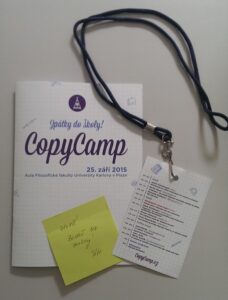
It is common knowledge that copywriters are a playful bunch, so the organisers prepared more than just interesting lectures. All participants received a themed notebook for notes, featuring portraits of the speakers and a homework assignment. Really. Anyone who correctly filled in the i/y and s/z in the fill-in-the-blank exercise received a sweet reward. Clearly, at AITOM, we know what we’re doing. For the fill-in-the-blank exercise, I got an A from the teacher-organisers, or rather a Fidorka.
Talking about all the lectures would take hours, so what interested us the most?
Why write your own obituary?
Roman Hřebecký from Pábení spoke about why the design process needs a copywriter. I didn’t know what to make of that either. Copywriting is all about understanding the client, so Roman recommended we think of writing as design.
The end customer comes first, then the business, and finally the technology. The text you use to speak to the customer is also a form of technology. But you can’t get to know the customer without talking to them. Roman emphasised how important it is to conduct research and to test, test, test. Only then can you create copy or a website that’s tailored to the client, rather than just a virtual shop window.
That is also why the text should be created right at the start of a website redesign and not left until the end, because anyone who writes lorem ipsum is slacking off on the copywriting. If you want to please Roman, remember the hashtag #nasratLoremIpsum.
But why write an obituary? Because few people can present their company and its story succinctly. After all, we only speak well of the dead, yet we tend to be honest. It’s a simple little game to help present a vision to an agency, or to help create a vision if you’re just starting out in business.
Copywriter’s karma
Josef Šlerka is more concerned with analysing texts than writing them. So his talk was, of course, full of strange diagrams and graphs that didn’t make sense at first glance. On second glance, however, it all became clear. On the internet, users create homophilic niches – which in practice means that people with similar interests unconsciously group together.
Facebook, for example, operates on this principle. The problem is that whatever you write comes back to you, so it’s a good idea to think about the kind of users you want to surround yourself with. Because who cares about laypeople? You want customers who will actually buy.
The anatomy of a brand
How are copy and brand connected? Very closely. Copy is the language of the brand. But can you present your own brand in 30 seconds? Karel Mindless Novotný dissected the brand for us and showed us how to learn to do it.
B = Behaviour
Your behaviour should reflect your inner world. It should be authentic. Do you watch TV quiz shows? AZ Quiz or X Factor? Everyone introduces themselves in a rather stilted way. Learn to briefly introduce your company on AZ Quiz.
R = Razor
Have you heard of the golden ratio in photography? Texts are similar; they’re the essential information you can convey in 30 seconds. So what would you say in response to the question on Jan Kraus’s show: “I hear you’re in business?”
A = Audience
It wouldn’t be the same without an audience. You most likely have more than one audience – each can be represented by a specific persona. It’s important to realise that you expect a different conversion from each one; some prefer to make a purchase, others just want to read blog posts.
N = No name
Have you ever considered that you might not need a logo or a slogan? Come to think of it, what is Apple’s slogan? Nobody knows, but people love Apple all over the world anyway. Some companies simply don’t need a slogan, corporate colours, and some don’t even need a logo, so why spend money on it?
D = Deliver
What are you best at? A tough question, but one that determines your success. A brand’s job is to meet and exceed all expectations. It doesn’t matter what you can do – you’re already in business for that. We, for example, can build a website. But what are you best at? The answer to this question explains why a customer should buy from you and, ideally, come back.
Are you interested in what others are saying about Copycamp? Follow the hashtag #skolnicopycamp
on Twitter.
P.S. The photo of the hall is courtesy of the Copycamp organisers
. Thank you for letting us use it.