
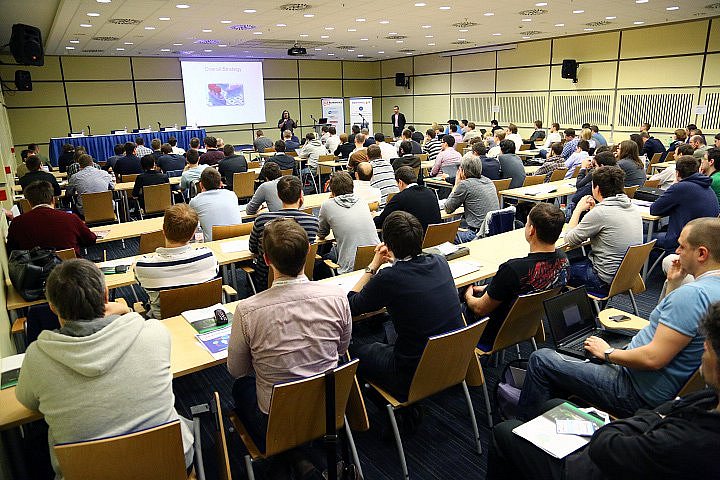
What attracted me most to the conference was that the morning session focused on the broader concept of UX design, specifically on introducing UX into companies, choosing a UX agency, and finding a ‘UX specialist’. The afternoon session was no less interesting. It focused more on specific websites and services where UX had been implemented.
Morning session
The first talk was delivered by Jan Sechovec and Nik Page from Česká spořitelna. It must be said that this very first talk was among the best of the whole day. It focused primarily on the implementation of UX within Česká spořitelna’s intranet. Nik was largely responsible for the success of this talk; his presentation skills impressed me perhaps even more than the content of the talk itself. As was mentioned later in one of the other talks, however, a proper UX professional must be able to present perfectly, because without enthusiasm for their work, they won’t convince company management to invest in UX. Nik certainly won’t have any trouble with that. The combination of treating work as a game and the fact that he clearly enjoys listening to himself makes him the ideal UX professional. I really liked the whole concept of ‘work as play’ – Nik called it gamification. Thanks to gamification, people will want to participate more in testing and will enjoy the work itself more (Nik looked like he enjoyed playing).
The following talk by Mr Marvan from Seznam.cz focused primarily on the fact that a UX designer should be in contact with the company’s management and explain the need for UX design directly to its members. Otherwise, the company won’t want to pay for it, because at present, few people in company management understand the importance of UX design in relation to customers, but above all in relation to the company’s future profits.
Out of the whole day, I was most intrigued by Mr Fendrych’s talk from ExperienceU, which focused primarily on how to select a UX designer. It was as if Mr Fendrych knew exactly why I had come to the conference; he kept spouting one interesting piece of information after another the whole time. So who is the right UX designer? Many companies think it’s a graphic designer who’s a master of Photoshop, can animate in Flash, and has a perfect grasp of jQuery scripting. According to Mr Fendrych, these are precisely the requirements that a UX designer doesn’t need to meet at all. It’s far more important that they understand psychology and sociology and are able to communicate perfectly. A proper UX designer must be able to get inside users’ heads so they can anticipate the problems users will encounter on the website and know how to solve them.
The panel discussion that followed wasn’t particularly interesting. I didn’t even expect it to be, given that only about 40 minutes had been set aside for it. That’s ridiculously little time to develop any sort of discussion.
Afternoon session
As I mentioned earlier, the afternoon session focused more on specific examples of implementing UX design into websites and applications. Mr Bíza from ‘Forrest’ used specific examples to show how they had improved websites, notably the Komerční banka website. Fortunately, it turned out that we’re doing things right at Aitom, as we follow a similar approach in many cases. The talks by Mr Jonka and Mr Hommer were also in a similar vein, presenting specific services. Both spoke primarily about what led them to create their products (in Mr Jonka’s case, Mobito; for Mr Hommer, it was music streaming), or rather, what needs they identified among their potential customers and how they decided to meet those needs.
In addition to the aforementioned speakers, the afternoon session also featured a talk by Mr Karlec from the 2fresh agency, who spoke about how a good website should be entertaining. That is to say, not only entertaining, but it must of course be functional and useful, and only on top of that should it be entertaining. Because if you leave a positive impression on a visitor, they will come back to you.
I’d sum up my overall impression of the conference as balanced, with one positive and one negative point. The positive was definitely that it was perfectly organised and met the expectations I had of it. It was an excellent insight into the world of user experience design. The negative was that there were too many speakers in too short a time; it certainly wouldn’t have hurt to extend the allocated time by two hours and thus give each speaker more space. The UX conference was beneficial and showed that UX is something that has an important place in the future and deserves attention. Aitom will certainly not be left behind.