
The website redesign was part of the overall modernisation of the WAMAG brand. Among other things, the brand was given a new logo and communication strategy. We wrote about the rebranding process here. Once the website was finalised, we also began working on marketing support.
You’ll see the results in a few months’ time
Redesigning a website and its structure carries risks. Over time, search engines get used to your URLs and include them in their index. As soon as a website changes its structure, the URLs usually change too. Even if redirects are set up, it takes search engines some time to index the new URLs. That is why there is often a drop in organic traffic immediately after a redesign. However, if you prepare well for the change, you may not notice any drop at all in the long term:


Any SEO specialist will advise you not to change URLs at all if possible. Sometimes, however, this isn’t feasible, and if you redirect URLs from the old to the new ones, you’ll still suffer a slight dip in organic search traffic. However, with careful work,
you can achieve much better figures within
a few months.
SEO, or Focus Your Energy on Improvements
SEO has a whole range of aspects and related fields; it is certainly not enough to just throw some keywords onto a page and wait. A well-optimised website is characterised by logic, clarity and interesting content. In other words, the user must find what they are looking for. That is why an SEO specialist is involved right from the preparation of the wireframes (model) for a new website.
It is well known that Google is striving to create an algorithm that ranks search results as closely as possible to the behaviour of a real person. It has long since moved beyond simply evaluating the number of keywords; instead, it focuses on the thematic and content structure of the entire website, including its usability.
To address this issue, we have implemented the Hotjar analytics tool on the site. This tool can (completely anonymously) record user behaviour on the page and directly capture their journey through the website. You can quickly identify where users are encountering problems and suggest a fix.
SEO work before and after
Unfortunately, search engine optimisation isn’t something you can simply switch on and tweak occasionally. It’s a continuous process that takes weeks and months.
During development, or rather at the start of it, we carry out keyword analysis and examine user behaviour online.
We look at what topics users associate with keywords, how they search for them,
and
whether they enter general keywords or tend to search for long, specific phrases. Thanks to this information, the SEO specialist, together with the UX designer, can propose a structure and outline the content for individual pages. In the case of the WAMAG website, the client prepared the content in-house based on our advice.
Just before completion, we fine-tuned the meta tags for the pages. This was to ensure that links to the website in search results encouraged users to click whilst also matching their search queries.
After launch, we gradually fine-tuned the content and so-called on-page SEO factors
. Hotjar’s output advised us where to look for shortcomings. We continuously monitored in Collabim how search engines were indexing the site and which pages (in which positions) were displayed for the tracked keywords.
Among the on-page factors we focused on were:
- Page structure and its specific content
- Meta tags
- Internal linking across the entire site
- Testing and optimisation of conversion elements
- URL addresses (these are, of course, addressed during development)
- Page load speed
- Optimisation of page navigation
Users will appreciate this kind of management. Compare user behaviour a year ago with today. The number of pages viewed per visit and the time spent on the site confirm that users are interested in the subject matter, and the website is guiding them to where they need to go.
Comparison chart for the periods 1 November – 31 November 2018 and 1 November – 31 November 2017 (i.e. one year after the redesign).

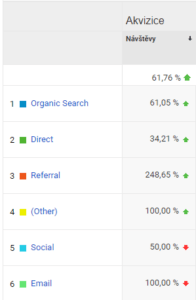
This is how the traffic structure has changed:
Specifics of the results in the B2B segment
A well-designed and optimised website delivers results. You should also see
these in the real world.
The website itself generated 17 enquiries via the contact form in 2018. This may seem like a small number, but in
the B2B
segment, enquiries
very often take place offline
.
The website contributed to a further 121 enquiries
that came in via telephone or email
, i.e. outside the website, although the website played a direct part in them. With the benefit of hindsight, the client rates
the website redesign and its results very positively
.
What exactly does WAMAG do?
WAMAG
is a family-run Czech company based in Mníšek pod Brdy. It was founded in 1994. It specialises in magnetic separation solutions for primary and secondary raw materials. It designs and manufactures magnetic separators for recycling, metal sorting, protecting technological equipment
from damage caused by stray metal objects, and the separation of metal particles across various industrial sectors.