

Google has long claimed that the user’s interests come first. It is therefore adapting its technologies and algorithms to best meet the needs of real people.
In January, Google announced that it would block intrusive adverts in the Chrome browser worldwide. The blocking will be based on the standards of the Coalition for Better Ads. Google banned intrusive ad formats quite some time ago.
Coalition for Better Ads
The Coalition for Better Ads is a group of leading companies in the advertising industry. Its aim is to rid the internet of overly aggressive adverts and thereby improve the reputation of digital marketing. Among Czech organisations, members include the Association for Internet Development (SPIR) and the Czech Association for Branded Products.
As a first step, the coalition surveyed 66,000 users in North America and Europe to gauge their views on advertising. Based on the results, it defined ‘standards for better advertising’. (It is clear that even the biggest players cannot make a move without data.) Detailed results and methodology in English can be found on the coalition’s website.
The Standards for Better Advertising prohibit:
Desktop/Classic website version

- Pop-up windows
- Autoplay video adverts with sound
- Countdown ads that block access to the page
- Ads that cover a large part of the screen
- Mobile
version
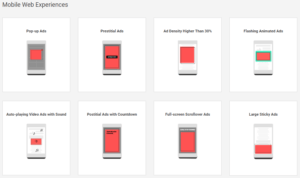
- Pop-up windows
- A window you have to click through before you can see the page content
- Ad density over 30%
- Flashing animated ad
- Autoplay video adverts with sound
- Countdown ads that block reading
- Full-screen scroll-over ad
- Ads that cover a large part of the screen
What does this mean for you?
If you advertise via Google, nothing changes for you. Google does not support such formats. However, if you use third-party pop-ups – such as mailing applications or lead-generation applications – consider whether you could get rid of these annoying formats.
You can check how Google sees your site in Webmaster Tools. However, the block should only affect a minimal percentage of the ad.
Other browsers aren’t too bothered by annoying ads
It appears that developers of other browsers are not planning to take similar action. However, Chrome is the most widely used browser. So it is definitely not worth ignoring.