Web design isn’t a printed business card; it’s not enough to choose a trendy font or an imaginative layout – it must also be user-friendly. That’s the mantra all web designers should bear in mind.
No trend emerges overnight. All the elements mentioned have been visible online for some time now, and we expect to see them become increasingly prevalent. Here are the top 4.
1. Gradients will replace plain backgrounds
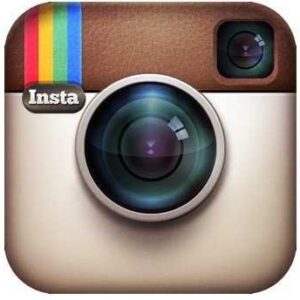
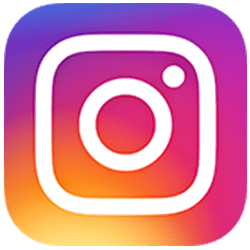
In design parlance, a gradient refers to a colour transition. Usually between two similar colours – for example, blue or green. The change to the Instagram logo is proof of this. On the left, you can see the 2013 version, and this is what it looks like today:
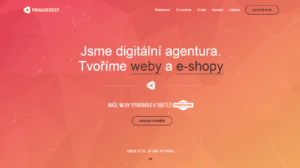
There are several ways to work with gradients, but the basic principles remain the same. You’ll most often encounter a two-tone gradient (occasionally a three-tone one). It’s a striking element, so it’s used in combination with simple elements (so-called flat design). Gradients often work with inner and outer shadows.
Here’s an example of how the PragueBest agency uses this trend:
2. Sliders are being replaced by animations and video
Many websites use sliders – that is, several banners with text that change. This element is ideal for e-shops promoting seasonal offers and other promotions.
However, the feature has also been adopted by websites that use it to showcase their competitive advantages or offers. Yet the slider scrolls slowly (otherwise the user wouldn’t have time to read the description), and users don’t like to wait. That’s why more and more companies are presenting the benefits of their services through video or animations, which are better at grabbing attention.
This is how Czech websites use animations.
For example, the homepage of the estate agency Svoboda&Williams immediately immerses you in examples of their interiors:
Our website VstupniStudie.cz also uses video, specifically as an illustration. A designer is drawing a wireframe for a mobile website:
3. Animations on the page
Animations also serve a purpose on websites, as they pull users out of their lethargy whilst scrolling. They can also draw
users brilliantly into the story
and the website itself. It is precisely this playful element that captures the user’s interest. You can work with these types of animations, for example:
- Parallax effect when scrolling
- Transition between pages
- Animations in certain sections
- Hover effects
Some animations can be heavy to load, so be careful. It is essential to test the animations to ensure they load quickly and do not test users’ patience.
You can find an excellent example on the Ecomail tool’s website. The animations show you just how easy the tool is to use:
Boring sliders can be presented in a very interesting way. For example, as on the website of the design studio MFart.cz:
4. Use of interesting typography
This trend is mainly seen on international websites, but it is also gaining ground in the Czech Republic. The underlying reason is primarily companies’ efforts to stand out and better present their philosophy. Logically, a lawyer cannot write in the same way as a skateboard manufacturer. This year, it is not just the content that will change, but the form as well.
Letters are thus becoming a powerful visual representation of the company. Fonts naturally evoke emotions in us as they speak to us.
Thanks to new technologies delivering higher-quality displays, designers can finally experiment with typefaces and use less traditional fonts. All browsers now support the option to create custom, so to speak ‘hand-made’, fonts tailored to a company’s needs.
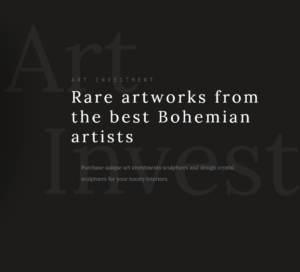
The trend is to use capital letters and contrasts between serif and sans-serif typefaces. This improves readability, looks more attractive and makes it easier to encourage users to read everything you’ve written for them.
Here’s how our graphic designer played around with fonts for a designer of luxury glass sculptures:
How should you approach trends?
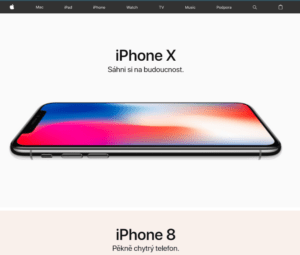
You can go with the flow and make use of them, or, conversely, go against the grain. Apple traditionally goes against the grain, being known for its minimalism. That, too, is a way to stand out from the competition. Generally speaking, it is always necessary to
consider the specifics of your industry
and the expectations of your customers.
It is also worth mentioning two trends in the field of development.
The first is ‘mobile first’. Google considers the mobile version to be decisive; if your mobile website doesn’t work properly, it won’t rate your site as useful for users and will prioritise your competitors in search results. That’s why it’s important to think from the outset about how animations and other modern features will work responsively on mobile devices. We’ve written about ‘Mobile First’ here.
The second is the much-discussed ‘ghost buttons’. These are buttons that are inconspicuous, for example, marked only by a border. Graphic designers love them because they blend discreetly into the design. UX designers hate them because users overlook them.
Since the user is always right, always design buttons to be prominent. There are numerous studies proving that a prominent button increases the conversion rate. So here at AITOM, we hope that 2018 will be the year when ghost buttons finally go to silicon hell (because they don’t deserve silicon heaven).