
What is tone of voice?
In marketing terms, tone of voice refers to the specific style of language you choose for your website. This includes whether you address users informally or formally, whether you adopt a highly professional or a more friendly tone, whether you use slang and colloquial expressions, and to what extent you employ technical terms, etc.
The choice of communication tone is also influenced by the brand and how you want your brand to come across to customers. Communication tone offers a brand the opportunity to stand out from its competitors.
It is precisely the difference between speaking to your doctor or a friend, even though both know you well.
Technical terms can put users off
Tech companies often struggle with the tone of communication, yet they sell their products to ordinary people. The company wants to maintain a professional image and use technical terms, but non-specialist users often don’t know them at all.
At AITOM, we addressed this issue for a construction company. Among other things, the company used the term ‘stavebník’. What do you think this word means? Testing revealed that most people planning to build a family home believe that ‘stavebník’ means ‘builder’. However, a ‘stavebník’ is someone who is building a house – in other words, an ordinary user like you or me. The company addressed its users as ‘builders’, for example, presenting subsidy options for builders. However, users left the site because they didn’t realise at all that this was an offer for them.
Where possible, avoid such specific terms, explain them, or create a glossary on the website.
How best to determine the tone of communication
Choosing the right tone of communication off the cuff is often a problem. The easiest way to determine the tone of communication is to first create personas. A persona is a specific representative of the target group. The main advantage is that when you speak to a specific person, you can better empathise with their needs and thus more easily offer them what they expect. Our template could help you create personas.
A persona contains the following information:
- Name
- Photograph
- Socio-demographic data – age, gender, place of residence, education, income
- Hobbies
- Brief daily routine
- What problems does the persona solve in relation to your offering
- Why does the persona buy your products
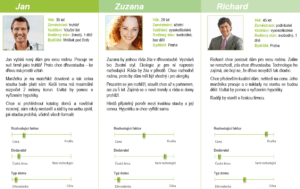
The resulting personas for a construction company might look something like this:
Don’t go overboard with the number of personas
. Three to five at most is enough; otherwise, you won’t be able to manage communication with them. The rule is that less is sometimes more.
5 steps to defining a persona
Step 1: Target audience
You surely know who you want to sell to. Although many companies think so, your target audience is NEVER EVERYONE
. Your customer will be limited in some way by age, gender, purchasing power, education, where they live, lifestyle, interests and so on.
For example, the Labeloo e-shop sells designer water bottles. Although everyone needs to stay hydrated, the target audience is very specific. According to data from Google Analytics and Facebook Insights, we know that the main buyers are young women who exercise.
Step 2: Hypotheses
Formulate some assumptions based on the data. What do users like about the brand, why do they buy your products specifically, what problems do they solve, and describe how their day unfolds in relation to your offering. This will help you understand where to reach them and how your products can, so to speak, suit their needs and make their lives easier.
Remember that a persona is a general representation
, but each of your customers is an individual. You will need to generalise and simplify some of your customers’ characteristics. You should develop hypotheses together with the sales team, who meet with customers.
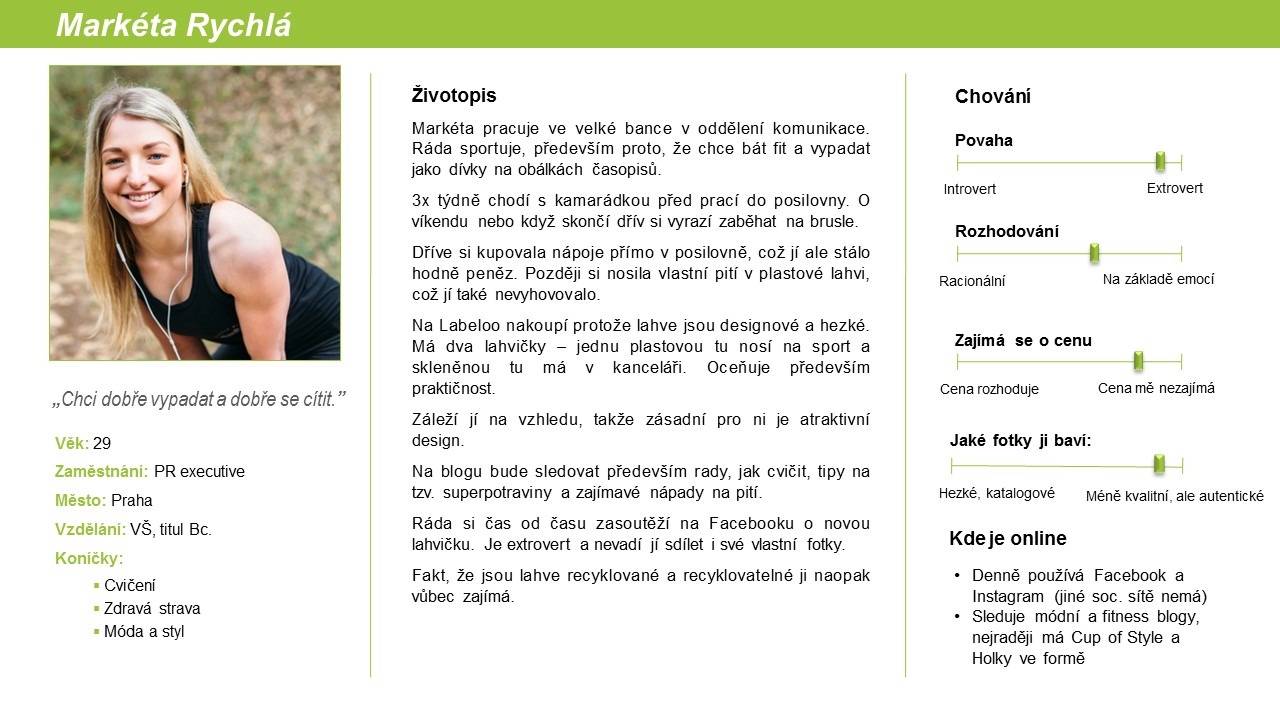
At Labeloo, for example, we created the persona ‘Markéta Rychlá’. Markéta is 29, lives in Prague, and exercises several times a week. She is interested in a healthy lifestyle. – We know all this based on data. Our hypothesis is that she cares about the environment (so she’ll want a recycled bottle), she also uses Instagram and Pinterest (where we’ll promote our products), and she practises yoga.
Step 3: Validating personas with users
Now take your persona and ask your users
if it fits. Whether they actually tackle these problems in the way you’ve identified. Real users might reveal strengths you didn’t even know you had.
At Labeloo, we asked several customers; you can do the same. Alternatively, you can create a simple questionnaire and ask users to fill it in. This would help you find out why they shop with you specifically. For example, we discovered that our customers aren’t interested in the environmental aspect of production, so there’s no point in mentioning it specifically. Our users also make little use of Pinterest, meaning investing in advertising there is a waste of money.
Step 4: Final personas
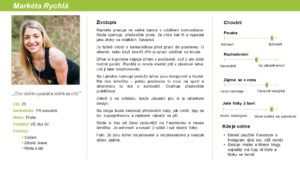
Based on the insights from testing the personas, finalise the personas and tailor your communication to them. At Labeloo, our final persona looks like this:
Now it’s easy, as you know what your persona does and where to find them.