
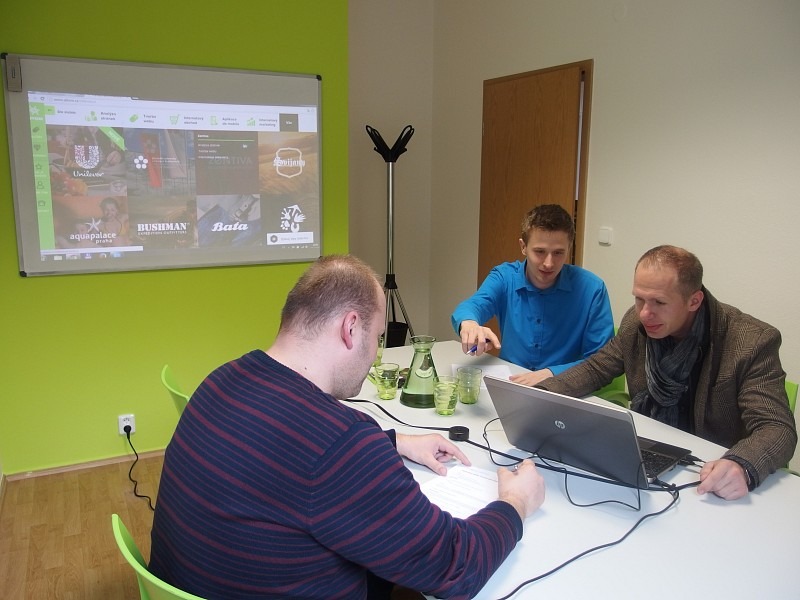
How many is enough?
Decide how many people you actually need present during the testing. If your tester feels like they’re in a zoo because even the receptionist is watching, the results are unlikely to be particularly relevant. The optimal number is 2–3 observers per tester. The most important person is the facilitator. This is the person who welcomes the tester, explains what is required of them, assigns tasks and communicates with them throughout.
If you feel that the entire development team and the graphic designer also need to see the test, find a suitable compromise. For example, you can use screen sharing to project the entire session onto a screen in another room. Then equip the testing room with a microphone. Observers will have all the necessary information – they will see and hear what is happening – whilst at the same time not unnecessarily stressing the tester.
Don’t forget to record
You must record the testing in some way. Consider which format is most suitable for you and your testers. Will they allow you to record the entire session on a camera or voice recorder? It is very important that the testers feel comfortable. If you are testing the Hackernews website, your users will probably mind being recorded. Always agree with the testers in advance and get them to sign a consent form for recording.
If you feel that recording might be a problem for them, simply take a notepad and pen. Under no circumstances should you record anything without the testers’ knowledge and consent.
Testing rules
First, go through the scenario with the colleagues who will be present during the testing and set the rules: Only the facilitator will
speak to the tester
. Of course, you will introduce everyone and shake hands. During the testing, however, observers do not speak; they simply take notes. At the end of the testing, there will be time for additional questions, at which point they may ask questions and add to their notes.
No one in the testing room must give any hints
– neither through words, gestures nor surprised expressions.
How does the testing proceed step by step?
Create a friendly atmosphere – it is important that the tester feels comfortable and at ease. We have prepared a simple structure to follow. But this is just a template. You do not have to stick to it strictly.
Inform the tester how the test will proceed
Welcome the tester and introduce them to everyone in the room. Explain to the tester how the whole test will proceed, and reassure them that they cannot make any mistakes – after all, you are not testing them, but the website. Ask them to think aloud
.
“Good morning, Mr Novák, thank you for coming. Let me first introduce our team. My name is Jan Dvořák, and I’ll be guiding you through today’s test. These are my colleagues Michela and Dana, our graphic designers, who will be taking notes throughout the testing. We’ll be testing the website muj-web.cz. Don’t worry about making any mistakes. We’re testing the site, and any observations you make will help us. Please think out loud. We have prepared a scenario and tasks for you, which will help us identify how we can improve the website. If any task is unclear, please don’t hesitate to ask me anything at any time. The testing will take about an hour. Do you have any questions? Right then, let’s begin. Imagine this situation… (present the scenario to the tester.)
Testing the competition and your website
Follow the prepared scenario. The facilitator should focus primarily on the tester; others should carefully note down everything essential.
During the test, the tester may be unable to complete a task. The reason doesn’t matter; if they can’t find the right button, there’s a flaw in the website’s design and you clearly know what to fix. In such a case, politely thank the tester and move on to the next task. They have still provided you with valuable feedback.
Do not let testers spend an unnecessarily long time on tasks; in reality, a user would not spend half an hour searching for a contact form just to arrange a meeting.
Space for additional questions
Finally, ask about strengths and weaknesses, and add to your notes. At this point, other observers may also ask questions.
Thanks and reward
Finally, thank the tester and emphasise how much they have helped you. Since the Phoenicians invented money, a simple thank you is no longer enough, so hand over the reward you agreed on beforehand.
Test evaluation
Once all testing is complete, begin the evaluation. Try to generalise the responses from all testers into guidelines that you can pass on to your developers and graphic designers. The sooner you process the responses after testing, the better. This way, you’ll still have a fresh memory of anything you may have forgotten to note down.
<< PREVIOUS PART
OF THE CASE STUDY >>
This article was originally published on mladypodnikatel.cz