

A whole range of factors play a part, one of the most important being the attention ratio. Oli Gardner, a world-renowned expert in conversion optimisation, discusses the attention ratio, for example:
The attention ratio indicates the relationship between the number of actions a user can realistically perform on a website and the response they should make.
A page’s potential to generate a conversion is very important. This is particularly true for landing pages to which you direct advertising campaigns (whether from PPC or Facebook). That is why it is better to direct users from an advert to a specific landing page rather than to a service page. On a landing page, you can significantly limit the number of actions that might distract the user.
It’s ideal if you can achieve a 1:1 attention ratio. Such a page then has a single goal, and that is the only thing the user can do on the page. Remember this simple rule: every page should have one goal and should guide the user towards it as much as possible.
Which pages to direct adverts to
The more general the page, the more actions can be performed on it. Take a look at your homepage, for example – it usually serves as a sort of hub.
There are essentially four types of pages to which you can direct your adverts:
- Homepage
- Internal page on the website (for example, it might describe a particular service)
- Landing page
- Microsite focused on a specific campaign
Let’s look at four pages on aitom.cz and calculate the attention ratio.
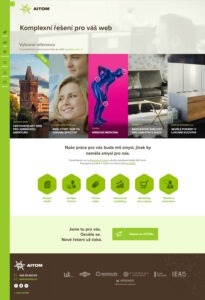
Attention ratio of the homepage:On the page, you can click on every menu item, select a reference or service, and further links are located in the footer; in total, 35 actions can be performed. The landing page is actually doing quite well – imagine a landing page for a large e-shop or information portal, where it would undoubtedly be possible to perform well over a hundred actions. The resulting attention ratio is 35:1. |
 |
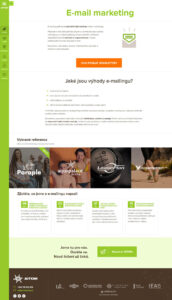
Attention ratio on an internal pageThe aim of this page is undoubtedly to get users to click the orange button and submit an enquiry. However, the page contains a whole range of elements that offer other actions. The problem with internal pages is their dependence on design. You cannot simply remove the menu or change the footer. The page contains elements designed to build trust (testimonials) and elements that demonstrate professionalism (articles). These elements can be removed to improve the ratio. The question is whether removing these elements would reduce conversion rates, as users would lack assurance of quality. The attention ratio is 30:1 |
 |
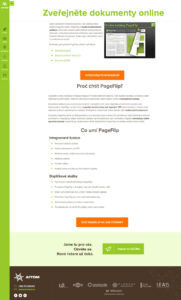
Attention ratio on the landing page:The page in the example serves as a landing page in PPC. It offers a web-based PDF reader. The page respects the site’s design – that is, the menu and footer. The attention ratio is 25:1 |
 |
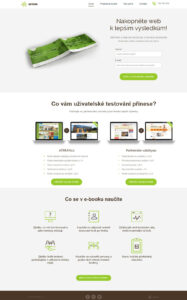
MicrositeThe microsite in the example has a single goal – downloading an e-book. It is designed for this purpose. The ratio is 12:1 |
 |
However, the attention ratio isn’t everything. Always think in context. You can guide users with prominent elements – in our cases, these are the orange buttons. Naturally, try to reduce the ratio, but always prioritise the user’s interests. It is more important that the user can navigate the site comfortably.
Generally speaking, the best option is a targeted microsite or landing page. A microsite is separate from the main site – it is more suitable for large campaigns, email campaigns, the sale of a special range or a new product type. A landing page, because it is part of your site’s structure, is suitable for promoting existing offers, services or anything else that needs to be promoted within the context of your business.
Test your results using A/B testing. You’ll find out, for example, whether you need quality endorsements on your landing page or internal page (in our case, articles and testimonials).