
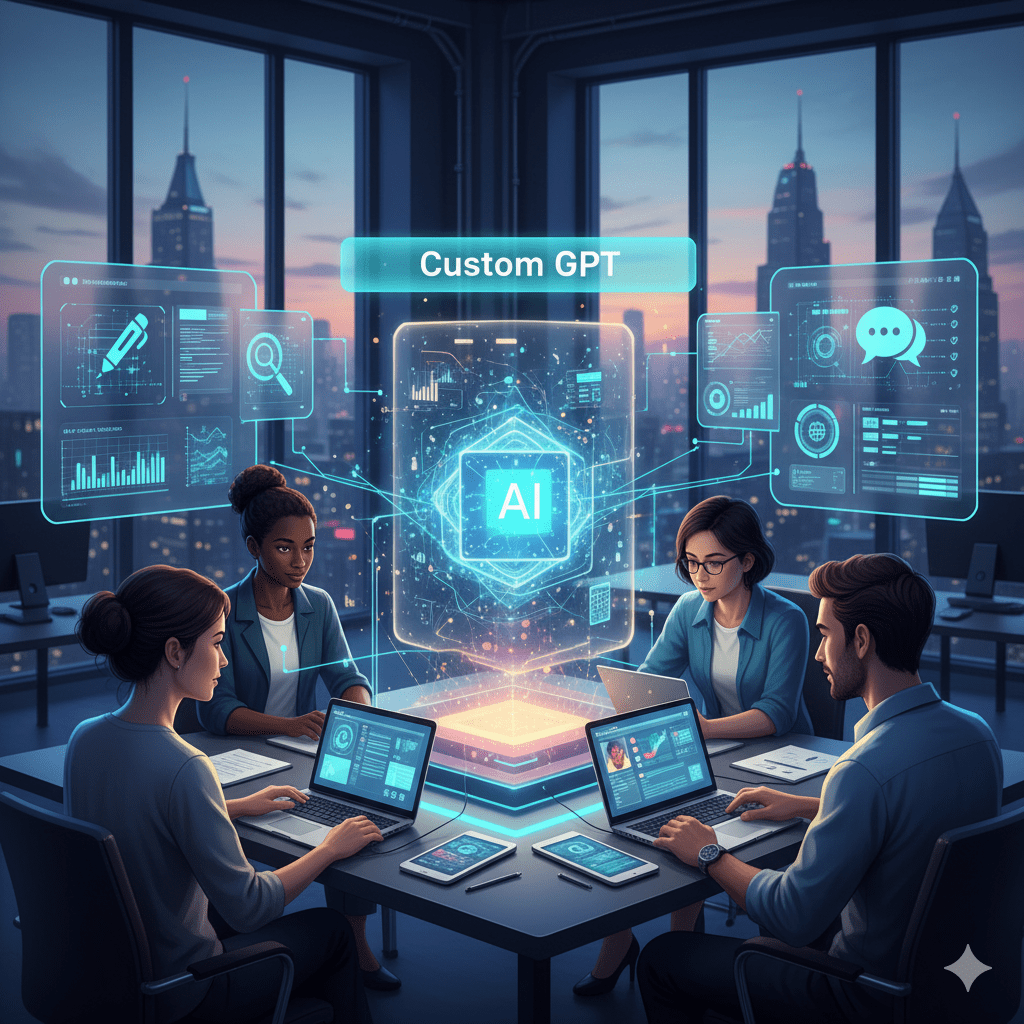
Artificial intelligence is becoming an increasingly important part of modern business. Agencies use AI for content creation, campaign automation, data analysis, customer support and project management. However, traditional tools offer limited customisation options. Custom GPT, a bespoke language model, enables agencies to create AI tailored precisely to their needs and brand. This article will show you how to deploy and utilise it effectively.
1. What is Custom GPT and why you should have it
Custom GPT is a language model tailored to your company’s specific requirements. Unlike a general-purpose AI tool:
- It understands your brand’s terminology and tone.
- It learns from your agency’s historical data and generates personalised recommendations.
- It can automate complex processes that standard tools would only partially manage.
For agencies, owning Custom GPT means not only faster content creation, but also better consistency in communication and the ability to scale services without immediately expanding the team.

2. Key areas of Custom GPT usage in an agency
a) Content creation and copywriting
Custom GPT can generate content that matches your brand’s style. This could include:
- Blog articles, product descriptions, newsletters, emails.
- Content for social media, including image captions and hashtags.
- Scripts for videos or podcasts.
Thanks to its own model, you don’t have to start from scratch – the AI prepares a draft, which the editor then simply fine-tunes. This dramatically reduces the time required for content creation.
b) Data analysis and reporting
Custom GPT can automatically analyse campaign results and prepare recommendations:
- It evaluates PPC campaigns, email marketing or social media performance.
- It generates visualisations, reports and insights in minutes rather than hours.
- It helps account managers make decisions based on data and trends.
c) Project management
The model can be integrated with tools such as Asana, Notion, ClickUp or Slack, thereby:
- Plans tasks and tracks deadlines.
- Prepares reports for team management.
- Coordinates workflows between different departments.
This allows the human team to focus on strategic and creative tasks, whilst the AI handles the routine work.
d) Customer support
Custom GPT can communicate with clients via chat, email or social media:
- It responds to common queries consistently and in line with the brand’s tone.
- It processes orders, bookings or service requests.
- It frees up human staff to focus on more complex issues and strategy.
3. How to create your own language model
Creating a Custom GPT isn’t complicated, but it requires a systematic approach.
- Define the purpose and objectives
- Decide which processes the model will automate.
- Set priorities – content creation, reporting, customer support or project management.
- Collect and prepare data
- Historical texts, internal documents, notes, FAQs, manuals.
- The data must be of high quality, relevant and consistent.
- Training the model
- Use platforms such as OpenAI Custom GPT, which allow you to train the model on your data.
- Define rules, tone of voice, output types and any content restrictions.
- Testing and fine-tuning
- Before deploying the model, test its outputs in various scenarios.
- By fine-tuning prompts and through internal iterations, you improve the quality and consistency of results.
- Integration into your workflow
- Connect the model to CRM, project management tools, email marketing or social media.
- Ensure monitoring and reporting so that the model’s performance can be tracked and optimised.
4. Ethics, security and compliance
Even your own model requires oversight:
- Legal compliance: AI must comply with the GDPR, copyright laws and advertising regulations.
- Ethical standards: Prevent discrimination, offensive content and misinformation.
- Data security: Ensure that sensitive company and customer data is protected.
Regular monitoring and team training will ensure that AI is an asset, not a risk.

5. Practical tips for effective deployment
- Start with a pilot project: Test the AI in a single department or for a specific type of task.
- Train the team: People need to understand how the model works and how to use it.
- Iterate and optimise: Monitor outputs, gather feedback and refine the model.
- Integrate with human oversight: AI complements human work, but does not replace it entirely.
6. Benefits of Custom GPT for agencies
- Brand consistency: Every output aligns with the company’s tone and values.
- Time savings: Automating routine tasks frees up dozens of extra hours each month.
- Better decision-making: The model analyses data and provides recommendations based on historical data.
- Better scalability: The agency can grow without immediately expanding the team.
- Competitive advantage: Companies with Custom GPT can respond more quickly to market changes.
Custom GPT is a tool that enables agencies to achieve faster workflows, higher service quality and better communication with clients. Proper implementation involves defining the purpose, data collection, training, testing, integration and ethical review. Agencies that utilise their own language model will gain a significant competitive advantage and be prepared for the future of digital business.