
Creativity in the Age of Artificial Intelligence
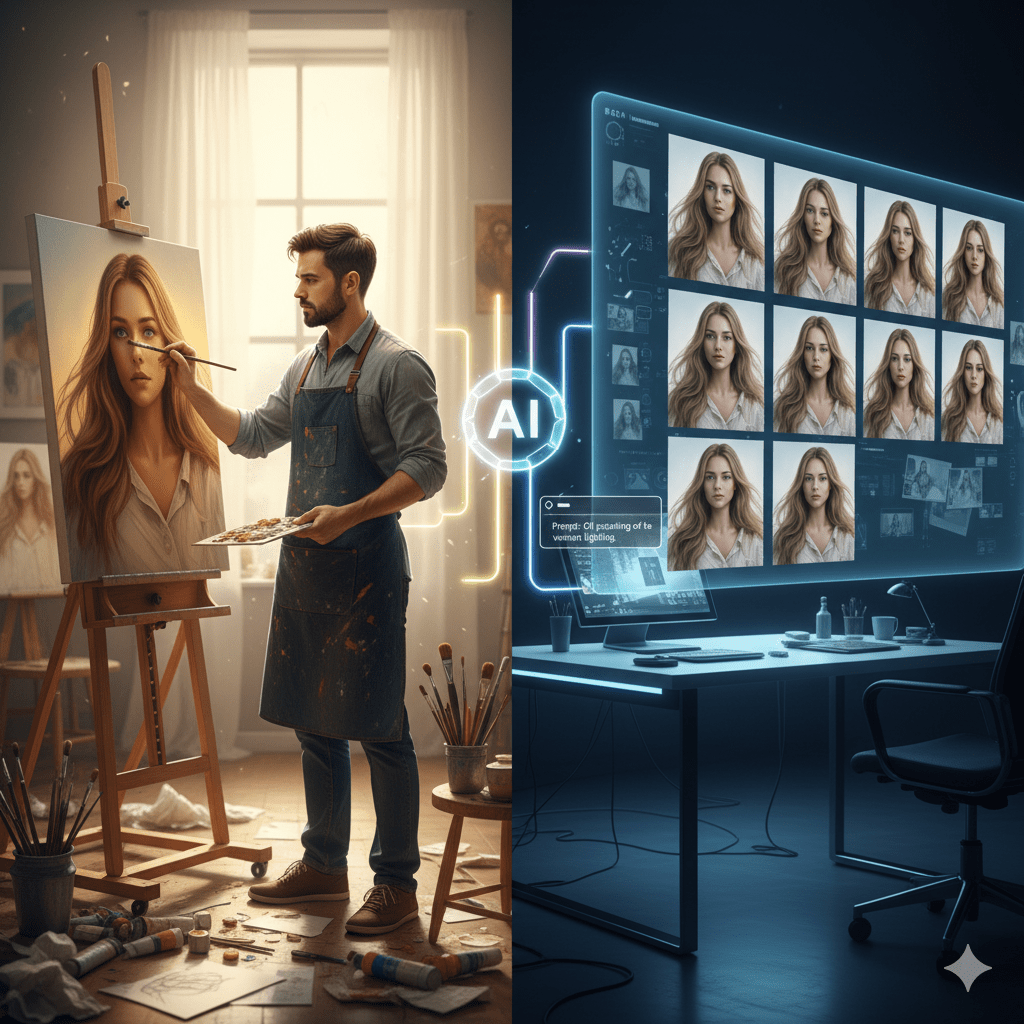
Just a few years ago, design was the preserve of creative teams and graphic designers who created a brand’s visual identity by hand, step by step. Today, however, thanks to generative AI, even entrepreneurs without in-depth graphic design knowledge can create designs, visuals or entire campaigns.
Tools such as Midjourney, DALL·E, Firefly, Runway, Leonardo AI and Canva AI can convert a simple text description (known as a prompt) into professional visual designs in a matter of seconds.
This article will show you:
- what generative design means,
- what its main benefits are for business,
- what tools are available,
- and how to start using AI strategically, not just experimentally.
What is generative design and why does it matter
Generative design represents a new way of creating, where AI does not merely follow commands, but designs and creates on its own.
An entrepreneur can simply ask, for example: “Create a minimalist logo for a natural cosmetics brand in soft green tones.”
Within seconds, they receive various design options to choose from and can customise them to suit their needs.
How AI helps businesses
- Faster visual production: AI can generate dozens of designs within minutes, significantly speeding up campaign creation and idea testing.
- Brand consistency: Tools enable the creation of consistent templates and the maintenance of visual identity across all channels.
- Personalisation: Content can be tailored to different target groups – for example, a different style for a young audience and another for corporate clients.
- Cost savings: Thanks to AI, small businesses can afford professional visuals even without large budgets.
Main areas of application for generative AI in visual content
Brand identity creation
Artificial intelligence now helps with the design of logos, colour palettes and typography. Tools such as Looka or Brandmark.io can create designs within minutes that match your style and target audience.
Visuals for marketing and advertising
Services such as Midjourney or Firefly can generate realistic photographs, illustrations and product visualisations. They are ideal for creating banners, social media posts or A/B testing multiple campaign variants.
Product design and 3D modelling
In industrial and product design, AI helps with the design of shapes, materials and ergonomics. Autodesk Generative Design can propose optimal structural solutions based on specified parameters (weight, strength, cost).
Video and multimedia content
Brand identity creation
Artificial intelligence now helps with the design of logos, colour palettes and typography. Tools such as Looka or Brandmark.io can create designs within minutes that match your style and target audience.
Visuals for marketing and advertising
Services such as Midjourney or Firefly can generate realistic photographs, illustrations and product visualisations. They are ideal for creating banners, social media posts or A/B testing multiple campaign variants.
Product design and 3D modelling
In industrial and product design, AI assists with the design of shapes, materials and ergonomics. Autodesk Generative Design can propose optimal structural solutions based on specified parameters (weight, strength, cost).
Video and multimedia content
Tools such as Runway or Pika Labs can create a video or animation from a text description. They enable smaller companies to produce high-quality video content without an expensive crew and production team.
The best-known AI tools for generative design
| Purpose | Tool | Description |
|---|---|---|
| Images and visuals | Midjourney, DALL·E, Leonardo AI | Generating realistic or stylised images from text. |
| Branding | Looka, Brandmark.io | Automatic logo and brand identity design. |
| Video and animation | Runway, Pika Labs, Kaiber | Generation of short videos and scenes. |
| Presentations and graphics | Canva AI, Tome.app | Assistants for creating presentations and materials. |
| Product design | Autodesk Generative Design, Fusion 360 | Designs of physical objects based on parameters. |
How to effectively integrate generative AI into your business
Start with a specific goal
Instead of experimenting ‘just for the sake of it’, set a goal – for example, to create ten visuals for a new campaign or to design a new logo.
Choose the right tool
Every tool has different strengths. Choose one that suits your purpose – some are better for marketing, others for product design.
Learn to write high-quality prompts
AI outputs are only as good as your instructions. Describe the style, colours, tone and target audience.
For example:
“Create a modern, minimalist banner for a fitness studio, in light blue colours, emphasising energy and motivation.”
Integrate AI into your processes
Don’t limit yourself to inspiration – incorporate AI into your daily content creation, marketing, or product processes.
Maintain human oversight
AI may be powerful, but it still lacks context and a feel for the brand. Final approval should always remain in human hands.

The benefits and limitations of generative design
Advantages:
- Fast and inexpensive creation of visuals.
- Ability to personalise and test multiple variants.
- Highly accessible, even for small businesses.
- Streamlining of work processes.
Limitations:
- Does not always capture the brand’s unique character.
- Outputs may be too generic.
- Questions regarding copyright and ethical use.
Generative design does not spell the end of human creativity – on the contrary, it enhances it. Entrepreneurs who learn to work with AI will gain a powerful ally for brand, content and product creation.
Start simple. Try generating your first visual, experiment with different tools, and gradually integrate AI into your visual strategy.
The future of design will not be about who has the most expensive software, but who is best at collaborating with artificial intelligence.