
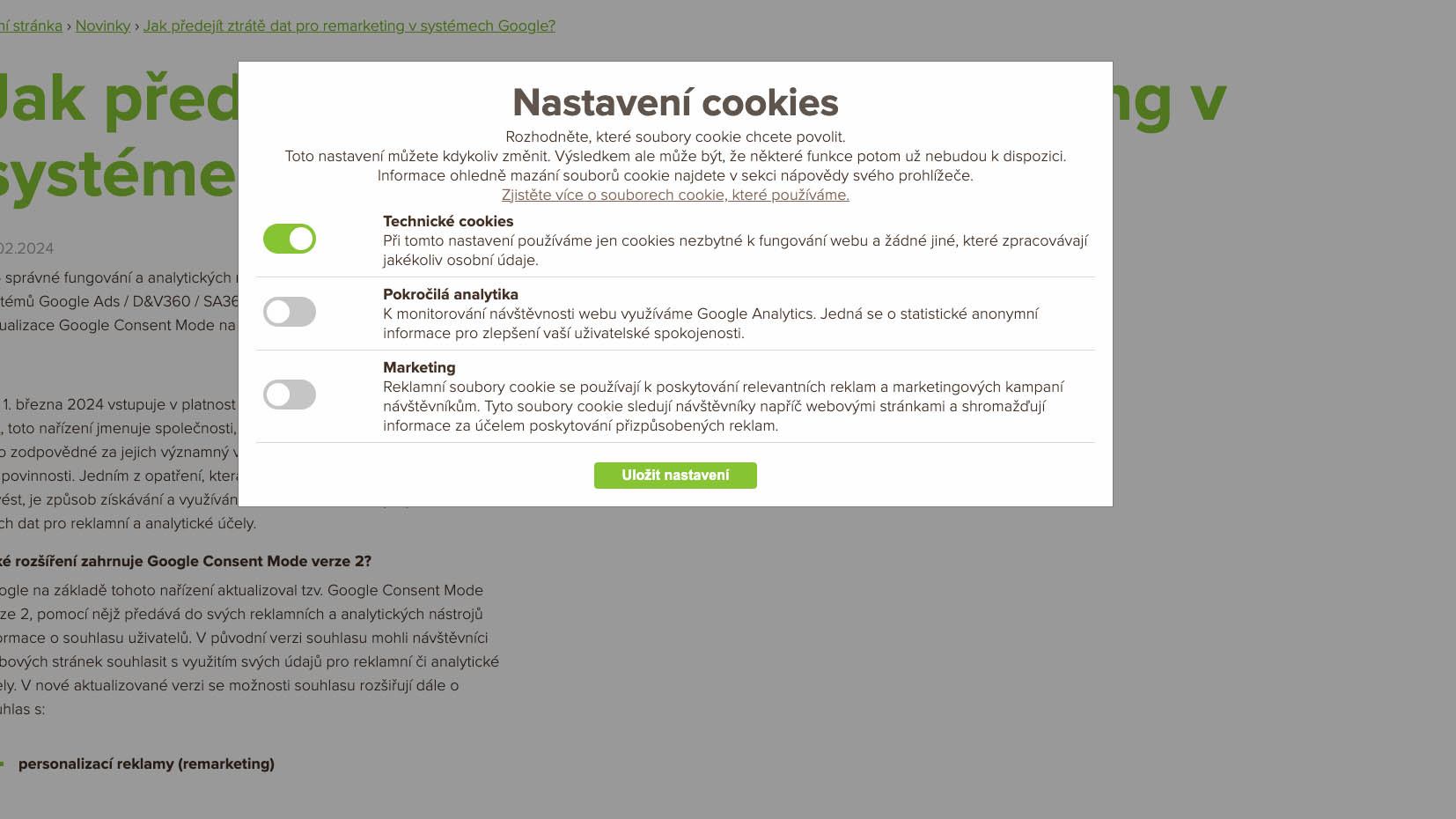
From 1 March 2024, the EU regulation known as the Digital Markets Act will come into force. This regulation designates companies, including Google, as having significant market power in the digital environment and imposes obligations on them. One of the measures Google must implement under the regulation is the method of obtaining and using users’ consent regarding the collection of their data for advertising and analytical purposes.
What does Google Consent Mode version 2 entail?
In accordance with this regulation, Google has updated ‘Google Consent Mode version 2’, through which it transmits information regarding user consent to its advertising and analytics tools. In the original version, website visitors could consent to the use of their data for advertising or analytics purposes. In the new updated version, the consent options are further expanded to include consent for:
-
ad personalisation (remarketing)
-
consent to the collection of user data.
Correct configuration of this update is essential for the proper functioning of Google Analytics and Google Ads.
Google Consent Mode version 2 (GCMv2) is available in two implementation variants: basic and advanced. The basic version has significantly limited data collection capabilities and is unable to measure any data if the user does not give their consent. In practice, this can result in the loss of up to several tens of per cent of data from these users regarding conversions or traffic sources, both in analytics and advertising systems.
In the event of user opt-out, the advanced integration version offers the measurement of certain key signals on the website, enabling it to model missing conversion or visit data much more accurately, in an anonymised form and whilst respecting the user’s opt-out. This data thus enables a much more accurate modelling of the actual performance of advertising campaigns and the website, allowing us to make much more precise and accurate decisions regarding website performance, traffic sources, and return on advertising investment.
How to correctly integrate Google Consent Mode v2?
If you have our cookie banner implemented, you must configure GCMv2 manually within Google Tag Manager. If Google products are important for your business, we recommend that you configure Consent Mode V2 well in advance of the start of March 2024 to minimise potential issues.
For customers who actively advertise via Google Ads and for whom optimising conversion performance is crucial, we recommend implementing ‘Enhanced Conversions’ within the Google Ads conversion tag. This provides an additional user signal to Google, enabling the measurement of conversions that would otherwise go unrecorded.
It is possible to send several pieces of data, such as First Name, Surname and Phone Number, but the most important is the email address.
Suitable for customers who track an e-shop order or a submitted form as a conversion, where user attributes can be utilised.
More in the Google Ads Help Centre
Facebook Conversion API
As a bonus (unrelated to Google Tag and the areas mentioned earlier) is the Facebook Conversion API (CAPI). This is an advanced method for tracking events compared to the client-side Facebook pixel. It involves server-to-server communication, where information is transferred about the user, pages visited, configured events, etc.
To set up advanced Facebook event tracking correctly, you need to set up your own server or a server-side GTM container hosted on the Google Cloud Platform and configure server-side tagging for Facebook events.
The Facebook Conversion API allows you to measure conversions more accurately and collect the maximum amount of data to improve the performance of your campaigns and partially offset losses caused by Apple’s iOS updates.
Price list
|
Basic |
Standard |
Pro |
|
|
Suitable for: |
|
|
|
|
Google Consent Mode 2 update |
YES |
YES |
YES |
|
Advanced Google Ads conversion tracking |
NO |
YES |
YES |
|
Facebook Conversion API |
NO |
NO |
YES |
|
Price: |
CZK 5,000* |
CZK 10,000* |
CZK 20,000* |
*Prices exclude VAT
Important: The price assumes that the client already has the GTM Cookie Bar implemented and configured. If the GTM Cookie Bar needs to be implemented, there is an additional charge of 10,000 CZK excluding VAT
If you are interested in implementation, please contact us.